📊 Full opportunity report: AI Signal Monitoring Signals A Shift Toward Infrastructure Giants on IdeaNavigator AI — validation score, market gap, and execution plan.

Get smart everyday buys delivered free with Prime
- Fast, free delivery on millions of items
- Prime Video, Amazon Music and more included
- Member-only deals all year
TL;DR
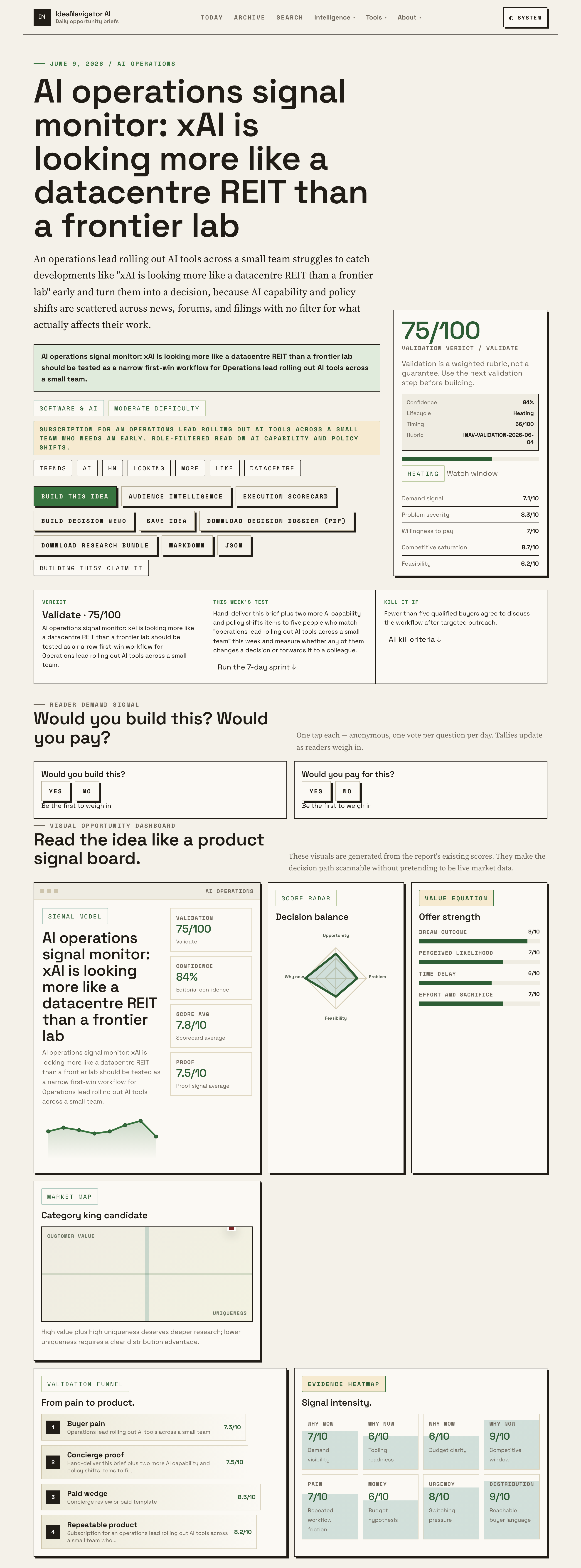
AI signal monitoring reveals a trend where AI companies are adopting infrastructure-like models, moving away from experimental labs. This shift could reshape industry dynamics and investment focus.
AI signal monitoring tools have identified a clear trend: AI companies like xAI are increasingly resembling infrastructure-focused entities, such as data center REITs, rather than frontier research labs. This shift, confirmed through recent signal analysis, indicates a potential transformation in how AI firms operate and are valued, which could impact industry investments and strategic decisions.
Recent data from specialized AI signal monitoring platforms highlight a pattern where AI companies are emphasizing infrastructure and operational scale over groundbreaking research. One notable example is xAI, which is reportedly adopting a model akin to data center REITs, focusing on infrastructure management and deployment rather than frontier AI development. This observation is based on signals surfaced by AI capability and policy shift trackers, which analyze news, forums, and filings to identify trends affecting AI operations.
The shift is driven by market and policy dynamics, with companies possibly seeking more stable, scalable revenue models centered on infrastructure. This is reinforced by signals from Hacker News, which rated these developments highly, indicating that industry insiders recognize this as a significant change. It is not yet confirmed whether this trend will accelerate or if other AI firms will follow suit, but early indicators suggest a strategic pivot towards infrastructure-centric models.
Implications of Infrastructure-Driven AI Business Models
This trend matters because it signals a potential shift in how AI companies are valued and operate. Infrastructure-focused models tend to prioritize operational scale, stability, and recurring revenue, which could lead to changes in investment patterns and competitive dynamics within the AI industry. For smaller or frontier AI labs, this shift might mean increased competition from larger, infrastructure-oriented firms, impacting innovation and funding landscapes.
For investors and industry watchers, understanding this movement is crucial, as it could influence the strategic direction of AI development and deployment, emphasizing infrastructure over experimental research. The trend also raises questions about the future of AI innovation—whether it will remain driven by frontier labs or be increasingly embedded within infrastructure giants.
Popular right now

Sony BRAVIA 5 85-Inch Mini LED 4K HDR Smart TV (K-85XR50)

Bose QuietComfort Wireless Noise-Cancelling Over-Ear Headphones, Black

De'Longhi Magnifica Evo Fully Automatic Espresso Machine with Manual Milk Frother, Silver
As an affiliate, we earn on qualifying purchases.
Recent Signals Indicate a Market Transition
The current trend emerges amid rapid policy and capability shifts within the AI sector. Signals surfaced through monitoring tools that scan news feeds, forums, and regulatory filings, revealing a growing emphasis on infrastructure-like characteristics among AI firms. Notably, xAI’s approach appears to be shifting towards operational scale and infrastructure management, similar to data center REITs, rather than pioneering new AI algorithms or models.
This development follows broader industry patterns where large tech firms and infrastructure providers are consolidating AI deployment capabilities, possibly to capitalize on the scalability and stability of infrastructure-based revenue streams. Historically, AI startups and frontier labs have focused on innovation and research, but recent signals suggest a strategic pivot among some firms toward infrastructure-centric models.
“The signals indicate a notable shift where AI firms are increasingly emphasizing infrastructure and operational scale over groundbreaking research.”
— an anonymous researcher
Unconfirmed Aspects of the Infrastructure Shift
It remains unclear whether this observed trend will accelerate across the broader AI industry or remain confined to specific firms like xAI. The long-term implications for AI innovation and startup funding are still uncertain, as signals are early and based on limited data points. Additionally, it is not yet confirmed if this shift is strategic or a temporary response to market conditions.
Monitoring Future Industry Movements and Signals
Next steps include tracking additional signals from AI companies, regulatory filings, and investor reports to confirm whether this infrastructure-oriented trend spreads. Industry analysts will also watch for shifts in funding, partnerships, and product strategies among AI firms. Further signal analysis and market data will clarify whether this is a lasting transformation or a transient phase.
Key Questions
What does it mean for AI startups?
It could mean increased competition from larger, infrastructure-focused firms, potentially impacting funding and innovation dynamics for smaller startups.
Why are companies shifting toward infrastructure models?
They may seek more stable, recurring revenue streams and scalability advantages associated with infrastructure management.
Is this trend confirmed across the entire AI industry?
No, it is based on early signals and specific cases like xAI; broader industry confirmation is still pending.
How reliable are these signals?
The signals are derived from monitoring tools analyzing news, forums, and filings, but their predictive power is still being evaluated.
What are the potential risks of this shift?
It could stifle innovation if the focus on infrastructure overshadows research, or lead to market consolidation that limits competition.
Source: IdeaNavigator AI