📊 Full opportunity report: An Empty Trust Tracker For Legaltech And Wealthtech Teams on IdeaNavigator AI — validation score, market gap, and execution plan.

Get smart everyday buys delivered free with Prime
- Fast, free delivery on millions of items
- Prime Video, Amazon Music and more included
- Member-only deals all year
TL;DR
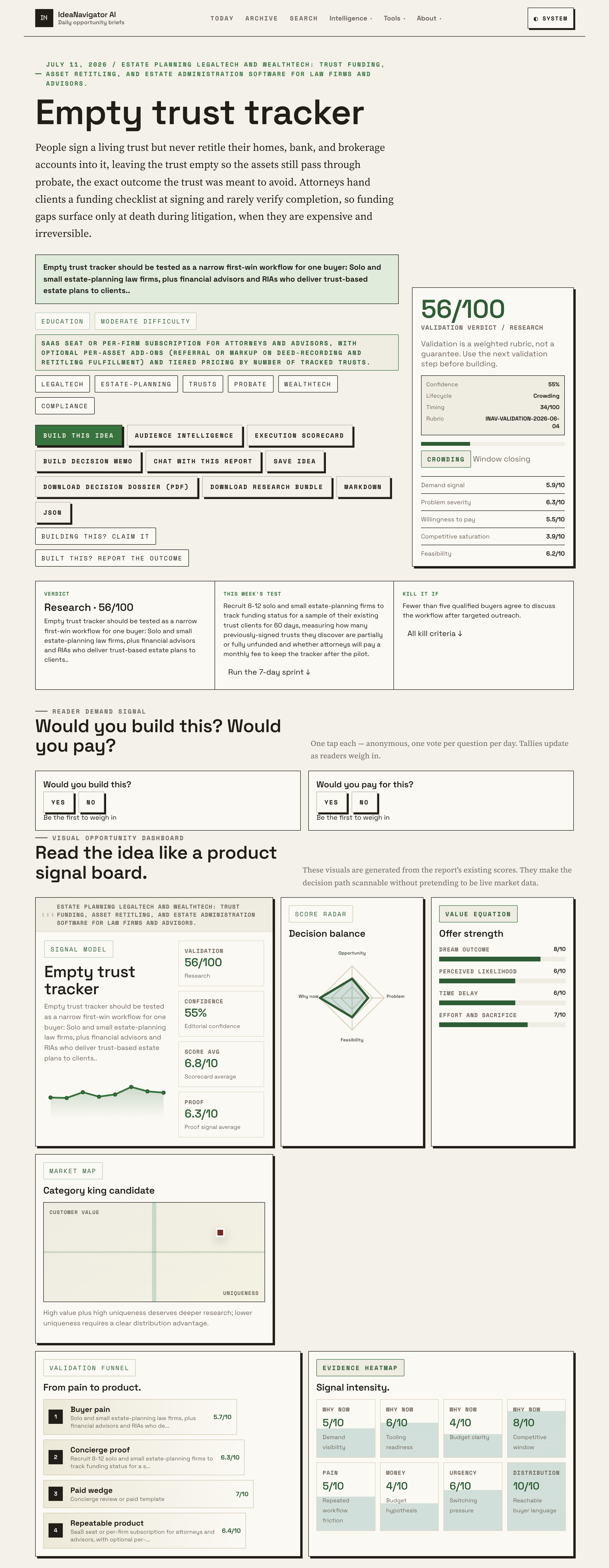
IdeaNavigator AI has published a product idea for an ’empty trust tracker’ — a SaaS tool that lets solo estate-planning attorneys and financial advisors verify whether client trusts are actually funded. The pitch argues that unfunded trusts are a common, costly gap that surfaces only at death, and proposes a 60-day pilot to validate demand.
IdeaNavigator AI has published a product proposal for an “empty trust tracker” — a software tool that would let solo and small estate-planning law firms, along with financial advisors and RIAs, monitor whether clients’ living trusts are actually funded with assets. The pitch targets a specific, expensive failure mode in estate planning: clients sign trusts but never retitle their homes and accounts, leaving the documents empty and forcing assets through probate anyway.
The core problem the proposal identifies is trust funding. Clients routinely sign a living trust but never complete the paperwork to move their home, bank accounts, and brokerage accounts into it. The result, according to IdeaNavigator AI, is an empty trust: the documents exist, but the assets still pass through probate — the exact court process the trust was designed to avoid. Attorneys typically hand clients a funding checklist at signing and rarely verify completion, the proposal states, so funding gaps surface only at death during litigation, when they are expensive and irreversible to fix.
The proposed minimum viable product is a client-by-client funding tracker. Attorneys or advisors would create a per-trust checklist covering real estate, bank accounts, brokerage accounts, retirement assets, business interests, and beneficiary designations. Each asset would carry a status — pending, in-progress, or confirmed funded — with proof attached, such as a recorded deed or a retitled account statement. Automated reminders would go to clients, and a firm-level dashboard would show the firm’s book of trusts by percent funded, letting partners flag dangerously empty trusts before a client dies.
The proposed revenue model is a SaaS seat or per-firm subscription for attorneys and advisors, with optional per-asset add-ons — referral fees or markups on deed-recording and retitling fulfillment services — and tiered pricing based on the number of trusts tracked. The target market is estate planning legaltech and wealthtech: trust funding, asset retitling, and estate administration software.
Why an Empty Trust Tracker Draws Interest Now
The proposal arrives as two trends converge. According to IdeaNavigator AI, estate planning adoption and digital tooling are surging in 2026, yet only about 11% of Americans hold a trust, leaving a large gap between documents signed and assets actually protected. Trust funding remains a manual, fragmented step that existing document-drafting software does not address, the analysis argues.
For advisors, the stakes are commercial as well as fiduciary. IdeaNavigator AI notes that advisors and RIAs are racing to bundle funded estate plans into client offerings, and that per-deed funding services priced from $250 have already created a paid market that a tracking and verification layer could sit on top of. For law firms, the tool addresses malpractice-adjacent risk: a trust that fails at probate because it was never funded is a common source of disputes against drafting attorneys.
How Trust Funding Slips Through the Cracks
: “Living trusts avoid probate only for assets titled in the trust’s name. Retitling a home requires recording a new deed; moving bank and brokerage accounts requires paperwork with each institution; retirement accounts and life insurance are generally handled through beneficiary designations rather than retitling. Each step is separate, and none is automatically verified when the trust is signed.
The prevailing practice, as described in the proposal, is a one-time funding checklist handed to the client at signing. Because attorneys rarely follow up, completion depends on client initiative — and funding gaps typically go undetected until estate administration, when heirs or litigators discover the trust holds nothing. The proposed tracker is positioned as the missing verification layer between document drafting and estate administration software.
What the Proposal Has Not Yet Proven
The tracker is a concept, not a shipped product. IdeaNavigator AI’s own analysis frames it as an idea to be tested, and several claims rest on market observation rather than measured data. The roughly 11% trust adoption figure is cited without a named underlying survey. It is not yet clear how many firms would pay a monthly subscription for verification work many currently treat as the client’s responsibility, nor whether advisors will adopt a workflow traditionally owned by attorneys.
The proposed validation plan is a pilot: recruit 8-12 solo and small estate-planning firms to track funding status for a sample of their existing trust clients for 60 days, measuring how many previously signed trusts turn out to be partially or fully unfunded, and whether attorneys will pay to keep the tracker afterward. Whether that pilot has begun, and what it finds, is not stated.
The 60-Day Pilot That Would Decide It
According to the proposal, the immediate next step is recruiting the pilot cohort of 8-12 firms and running the 60-day tracking exercise on existing trust clients. Two metrics would determine viability: the share of already-signed trusts discovered to be unfunded or partially funded, and the share of attorneys willing to pay a monthly fee to keep the tracker after the pilot ends.
Readers interested in the full proposal can review it at IdeaNavigator AI’s published idea page. No launch date, pricing, or named early customers have been announced.
Source: IdeaNavigator AI
Key Questions
What is an empty trust?
An empty trust is a living trust that was legally signed but never funded — the client never retitled their home, bank, or brokerage accounts into it. Because probate avoidance depends on how assets are titled, not on the document itself, unfunded assets still pass through probate.
Is the empty trust tracker an available product?
No. It is a product concept published by IdeaNavigator AI, with a proposed MVP and a validation plan. No launch date, pricing, or customers have been announced.
Who would use the tracker?
The proposal targets solo and small estate-planning law firms, plus financial advisors and RIAs who deliver trust-based estate plans to clients.
How would the tracker be validated?
IdeaNavigator AI proposes recruiting 8-12 firms to track funding status of existing trust clients for 60 days, measuring how many trusts are discovered unfunded and whether attorneys will pay to keep the tool after the pilot.
How would the product make money?
Through a SaaS seat or per-firm subscription, with optional per-asset add-ons such as referral or markup revenue on deed-recording and retitling services, and tiered pricing by number of trusts tracked.
Source: IdeaNavigator AI
Fall Picks
fall essentials
As an affiliate, we earn on qualifying purchases.