🔍 Read the full analysis: Mac Mini Local AI: Matching Model Size To Available Memory on ThorstenMeyerAI.com

Get smart everyday buys delivered free with Prime
- Fast, free delivery on millions of items
- Prime Video, Amazon Music and more included
- Member-only deals all year
TL;DR
Apple is positioning its Mac mini for local AI, but the model a system can run depends chiefly on its unified memory. Published specifications indicate that 16GB to 64GB configurations can accommodate some quantized open models, while larger models may require more memory or multiple computers; speed also trails high-bandwidth data-center GPUs.
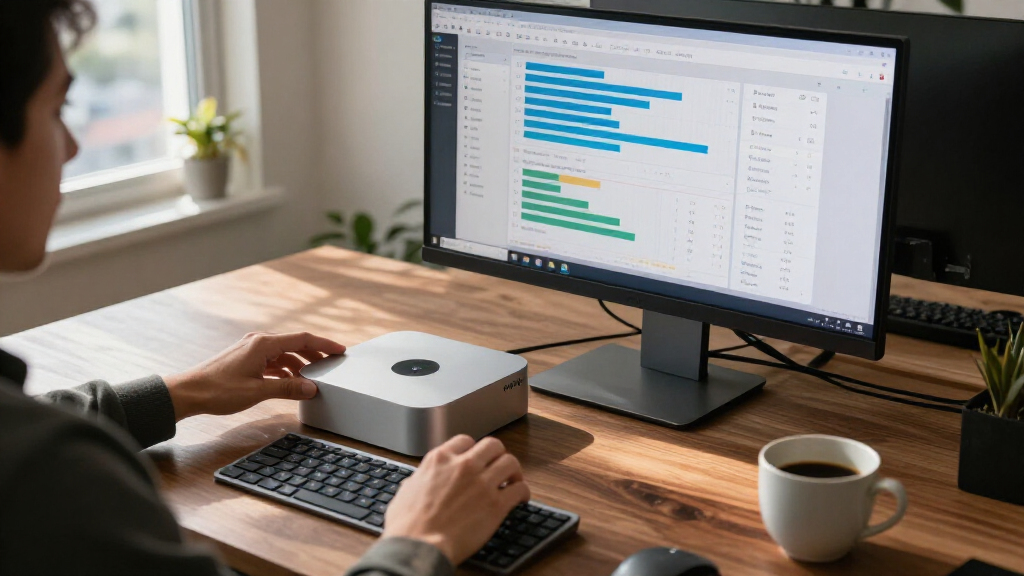
Apple is marketing its Mac mini as a desktop for always-on AI agents, but the system’s 16GB to 64GB of unified memory determines which models can realistically run on it. Published requirements from Google and OpenAI show that some smaller or quantized open models can fit, while larger models exceed the memory in even the most expensive Mac mini configuration.
Apple’s current lineup, as listed on its U.S. website on November 16, 2026, includes M6 models with 16GB, 24GB or 32GB of unified memory and M5 Pro models with 24GB, 48GB or 64GB. Listed prices range from $899 for a 16GB M6 configuration to $3,199 for an M5 Pro model with 64GB and 1TB of storage. These are prices reported by Apple’s site on that date, not a claim about future pricing.
Model requirements illustrate why memory capacity matters. Google lists its Gemma 4 31B model at about 17.5GB at 4-bit precision and 34.9GB at 8-bit precision. That makes the 4-bit version a possible fit on a 32GB system and the 8-bit version a possible fit on a 64GB system, but those figures cover model weights, not the additional memory used by macOS, other applications and the model’s context. The same model at 16-bit precision is listed at 69.9GB, more than the largest Mac mini’s memory.
OpenAI says gpt-oss-20b runs “within 16GB of memory,” while its documentation sizes the 117-billion-parameter gpt-oss-120b for a single 80GB GPU. The published figures describe different hardware and model conditions; they do not guarantee a particular speed or user experience on a Mac mini. Apple says its Thunderbolt 5 connections can be used to cluster multiple Mac minis to run larger models on-device, but the supplied material does not give performance results for such a setup.
Memory Sets the Local AI Ceiling
For people considering an AI computer at home or in a small office, the main decision is not simply whether a model can launch. The machine must hold the model’s weights while also leaving room for the operating system, applications and the prompt history or documents being processed. A configuration that barely fits the weights may not leave enough room for practical use, especially with a long context.
Local operation can offer offline access and control over where data is processed, and it avoids per-token charges for use of a hosted service. Those advantages do not make local inference free: the computer has an upfront price, uses electricity, and may deliver responses more slowly than a cloud service. The source material says the Mac mini idles at about 4 watts while an agent waits, but does not provide a complete cost comparison with cloud use.
Speed is a separate constraint. Apple lists memory bandwidth of 153 to 170GB/s for M6 Mac minis and 307GB/s for M5 Pro models. Nvidia specifies 3.35TB/s for the H100 SXM, about 11 times the M5 Pro figure. That comparison concerns published memory bandwidth, not a direct benchmark of model response times; actual performance depends on the model, software and workload.
Popular right now

Vitamix Touch & Go Advance 32-Ounce Bar Blender, White

Roborock Q7 M5+ Robot Vacuum and Mop with Self-Emptying Dock

Bose QuietComfort Headphones, White Smoke
As an affiliate, we earn on qualifying purchases.
How Unified Memory Shapes Model Fit
Apple silicon uses a unified memory architecture, giving the CPU and GPU access to the same pool rather than reserving a separate bank of graphics memory. Apple’s MLX documentation describes that shared access. It can make a Mac’s full memory pool useful for model weights, but that pool is not dedicated to AI: the operating system and running applications also draw on it.
Models store learned numerical weights that must be available as the system generates an answer. Quantization reduces the memory needed to store those weights by using lower precision, such as 4-bit rather than 16-bit values, and can affect quality. Google’s Gemma documentation cautions that its stated memory requirements cover static weights only and that larger context windows need additional memory.
Parameter count alone can also mislead. Google’s Gemma 4 26B A4B is a mixture-of-experts model that activates four billion parameters per token, but Google says all 26 billion parameters must be loaded into memory. Apple’s August 25 announcement called the Mac mini “the leading desktop for always-on agentic computing.” On an April 30 earnings call, Tim Cook said customer recognition of the Mac mini and Mac Studio as AI platforms was growing faster than Apple had predicted, according to MacRumors.
“the leading desktop for always-on agentic computing”
— Apple, in its August 25, 2026, Mac mini announcement
Real-World Performance Still Varies
The cited model-size figures do not establish how fast each model will respond on each Mac mini configuration, or how much memory a particular prompt and context will require. Google’s figures cover weights alone, while memory for macOS, applications and context varies by workload. The supplied material also does not include independent benchmarks comparing local Mac mini performance with cloud services.
Apple says Thunderbolt 5 can connect multiple Mac minis to run larger models on-device, but details such as scaling performance, software requirements and total cost are not provided here. It is also unclear from the cited specifications how much memory remains available to a model after the system and a user’s applications are running.
Check Fit Before Choosing a Configuration
Anyone planning to run a model locally should compare its published memory requirements with the Mac mini’s configurable unified memory, then leave headroom for the operating system, applications and context. A model listed as fitting within a system’s total memory may still be a poor practical fit if the available headroom is small.
Further evidence would come from model-specific benchmarks on each Mac mini configuration, including response speed, memory use with longer contexts and results from multi-Mac clustering. Until those details are available, the published specifications establish a useful capacity guide, not a guarantee that every model will run smoothly.
Key Questions
Which Mac mini configuration can run local AI models?
It depends on the model and its precision. The Mac mini configurations described here offer 16GB to 64GB of unified memory. Google’s figures put Gemma 4 31B at 17.5GB at 4-bit precision and 34.9GB at 8-bit, before memory for macOS, applications and context.
Does a model’s listed memory requirement include macOS and prompts?
Not always. Google says its Gemma memory figures cover static model weights and that larger context windows need additional memory. The operating system and other applications also use the Mac’s shared memory pool.
Can the 64GB Mac mini run OpenAI’s gpt-oss-120b?
The source material says OpenAI sizes gpt-oss-120b for a single 80GB GPU. That exceeds the 64GB memory capacity of the largest Mac mini configuration cited here. Apple says multiple Mac minis can be clustered, but no performance results are provided.
Is a local Mac mini as fast as a data-center GPU?
The published memory-bandwidth figures differ: Apple’s M5 Pro Mac mini is listed at 307GB/s, while Nvidia lists 3.35TB/s for the H100 SXM. This is not a direct response-time benchmark, but it shows that the hardware has different memory bandwidth.
Source: ThorstenMeyerAI.com