
🔍 Read the full analysis: Self-Checkout: Customers Scan, Bag, And Pay on ThorstenMeyerAI.com

Get smart everyday buys delivered free with Prime
- Fast, free delivery on millions of items
- Prime Video, Amazon Music and more included
- Member-only deals all year
TL;DR
Self-checkout systems transfer scanning and bagging tasks from cashiers to customers, a change that the U.S. Bureau of Labor Statistics says reduces labor needs. The agency counted about 3.1 million cashier jobs in 2025 and projects a 6% decline from 2025 to 2035. Retailers’ use of the systems varies, with some scaling back and others adopting them.
A November 26 report on self-checkout traces how supermarkets shifted some checkout work to customers and cites U.S. Bureau of Labor Statistics figures showing about 3.1 million cashier jobs in 2025. The agency projects cashier employment will fall 6% from 2025 to 2035, while the report notes that retailers have responded to self-checkout in different ways, including scaling some systems back.
The report places modern self-checkout within a longer history of customer-performed retail work. In 1916, Clarence Saunders opened Piggly Wiggly in Memphis, where shoppers selected goods from shelves rather than asking clerks to retrieve them. Saunders filed a patent for a “self-serving store” in October that year; it was granted in 1917. The store still relied on staff to check purchases and take payment.
Barcode scanning supplied a later step toward automated checkout. GS1 says a ten-pack of Wrigley’s Juicy Fruit gum was the first product scanned using a barcode, at a Marsh supermarket in Troy, Ohio, on June 26, 1974. In 1984, David R. Humble and colleagues filed a patent for a system in which shoppers scanned items themselves. The patent described weight checks and a mechanism intended to prevent customers from reaching into the scanning tunnel. The report says the system was later installed at several Kroger stores.
The labor figures show both a decline and the continuing scale of the occupation. The report cites BLS data counting 3,596,630 cashiers in May 2019 and 3,089,410 in May 2025. It calculates that as a drop of about 14%; that comparison spans a period that included the pandemic and growth in online shopping. The agency’s separate 2025 employment figure is 3,106,300, and its outlook projects a 6% decline by 2035, or about 200,600 fewer jobs.
Infographic 01 · A short history of self-service
From the clerk to the customer, 1916 to today
Each step moved a piece of the work across the counter: first fetching the goods, then reading the price, then scanning and ordering.
How the customer took over the clerk's work
- Before 1916: a clerk fetched, weighed and wrapped every item at the counter.
- 1916, Piggly Wiggly (Memphis): shoppers take the goods off the shelves themselves and pass a checking station to pay. Clarence Saunders files his patent on 21 October 1916.
- 26 June 1974, Troy, Ohio: a ten-pack of Juicy Fruit gum is the first product scanned with a barcode. A machine now reads the price.
- 9 July 1984: David R. Humble and two colleagues file the CheckRobot patent: the shopper scans, a scale checks the weight, a tunnel stops unscanned items. Payment still goes to a cashier.
- From 1986: CheckRobot machines in several Kroger supermarkets, as reported by CNN (2022).
- 2018: McDonald’s has kiosks in nearly 17,000 restaurants; in France, Italy and Spain well over half of in-restaurant orders go through them (company filing).
Sources differ on the exact opening day of the first Piggly Wiggly (6 or 11 September 1916). The Kroger installation is reported second-hand; we did not retrieve the 1987 newspaper original.
Sources: C. Saunders, US Patent 1,242,872 (1916/17); Tennessee Encyclopedia; GS1 Belgium & Luxembourg; Humble et al., US Patent 4,676,343 (1984/87); CNN (2022); McDonald's Form 10-K 2018.
Powered by Thorsten Meyer AI
Who Takes On Checkout Work
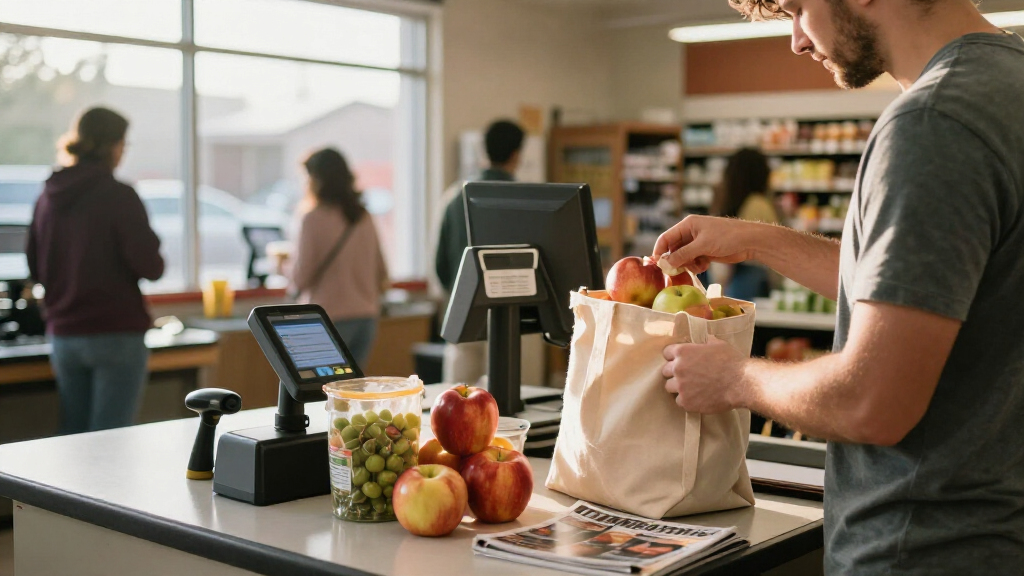
Self-checkout changes more than the equipment at the front of a store: customers take on tasks that cashiers traditionally performed, including scanning and bagging. The BLS identifies self-service checkout stands and rising online sales among the reasons it expects cashier employment to decline. The report also cites the agency’s January 2026 review, which says the main task of scanning and bagging is transferred to customers.
For shoppers, the systems can mean handling checkout themselves rather than waiting for a cashier. For retailers, the reported rationale includes reducing personnel costs and allowing one worker to supervise several stations. The report does not quantify how much stores save, how the systems affect wait times overall, or how customers experience them, so those outcomes should not be assumed from the employment figures alone.
The projected decline does not mean the occupation has disappeared. The report places cashier employment above three million in 2025, making clear that automation has changed the job, not removed it. The figures also describe a forecast, not a guarantee of what employment will be in 2035.
Popular right now

Vitamix Propel Series 510 Professional-Grade Blender, Black

Dyson Cyclone V10 Origin Cordless Vacuum

Apple AirPods Pro 3 Wireless Earbuds with Active Noise Cancellation
As an affiliate, we earn on qualifying purchases.
From Store Aisles to Scanners
The report’s historical thread begins with a change in who selected merchandise. At Piggly Wiggly, customers moved through aisles and picked goods from shelves; workers continued to handle the final checking and payment. Saunders’ 1916 patent described a layout directing shoppers past merchandise before they reached a checkout point. The account characterizes this as an early transfer of part of the clerk’s work to the customer, not as the invention of the modern checkout machine.
The barcode made it possible for a machine to read product information at checkout. A decade after the first reported barcode scan, the 1984 self-service system patent set out a further change: shoppers would operate the scanner themselves. Yet the patent’s process still ended with a cashier collecting payment. That detail shows how early automation could redistribute tasks without eliminating staff from the transaction.
Adoption has not moved in one direction everywhere. The source report says some retailers in England and the United States, including Booths, Dollar General and Target, pulled back on self-checkout between 2023 and 2024, citing service, losses and speed. It also describes continued adoption in Germany and Japan. These examples indicate different retail choices; the report does not provide a common measure for comparing adoption or outcomes across countries.
“Self-checkout reduces the need for labor because the main task of scanning and bagging items is transferred to the customer.”
— U.S. Bureau of Labor Statistics, January 2026 review of its previous projection round
What Employment Projections Cannot Show
The BLS projection is an estimate, not a confirmed future outcome. The report says the agency expects cashier jobs to decline 6% between 2025 and 2035, but does not establish how much of any eventual change will be caused by self-checkout rather than online sales or other forces. Its cited figures also come from different BLS measures: May employment estimates and an occupational outlook figure, so they should not be treated as identical counts.
The report gives examples of retailers scaling back or expanding self-checkout but does not provide a complete account of current adoption, the number of machines in use, or comparable evidence on theft, staffing, service quality and checkout speed. It is also unclear from the material how many cashier workers move into other roles when stores change their checkout arrangements.
The 2035 Employment Outlook
The next stated benchmark is the BLS forecast for 2025 to 2035: a 6% reduction in cashier employment, equivalent to about 200,600 fewer jobs according to the report. The agency cites self-service checkout and increasing online sales as reasons for the expected decline. Updated employment data and later revisions to the outlook will show whether the projection tracks actual changes.
In the meantime, retailers’ decisions remain an important part of the story. Some have pulled back on self-checkout, while others continue to use it or combine customer payment with staff assistance. The source material does not identify a single approach that retailers will adopt broadly, leaving the extent of future use—and its effects on workers and customers—open.
Key Questions
How many cashier jobs were there in the United States in 2025?
The report cites a BLS occupational outlook figure of 3,106,300 cashier jobs in 2025. It also cites a separate May 2025 estimate of 3,089,410; those figures come from different measures.
How much does the BLS project cashier employment will decline?
The BLS projects a 6% decline from 2025 to 2035, or about 200,600 fewer jobs, according to the report. This is a forecast, not a confirmed future count.
When did shoppers first scan a product using a barcode?
GS1 says a ten-pack of Juicy Fruit gum was scanned at a Marsh supermarket in Troy, Ohio, on June 26, 1974, in what it identifies as the first barcode product scan.
Are retailers all expanding self-checkout?
No. The report says some retailers in England and the United States reduced or removed self-checkout between 2023 and 2024, while it describes continued adoption in Germany and Japan. It does not provide a single current adoption rate across retailers.
Source: ThorstenMeyerAI.com