🔍 Read the full analysis: How AI Tools Are Finding Their Way Onto Farms on ThorstenMeyerAI.com

Get smart everyday buys delivered free with Prime
- Fast, free delivery on millions of items
- Prime Video, Amazon Music and more included
- Member-only deals all year
TL;DR
Farm machinery increasingly uses satellite guidance, precision tools and robotic milking, while adoption varies sharply by farm size and type. Strawberry harvesting remains difficult to automate, and the source material does not establish how much of the technology specifically uses AI.
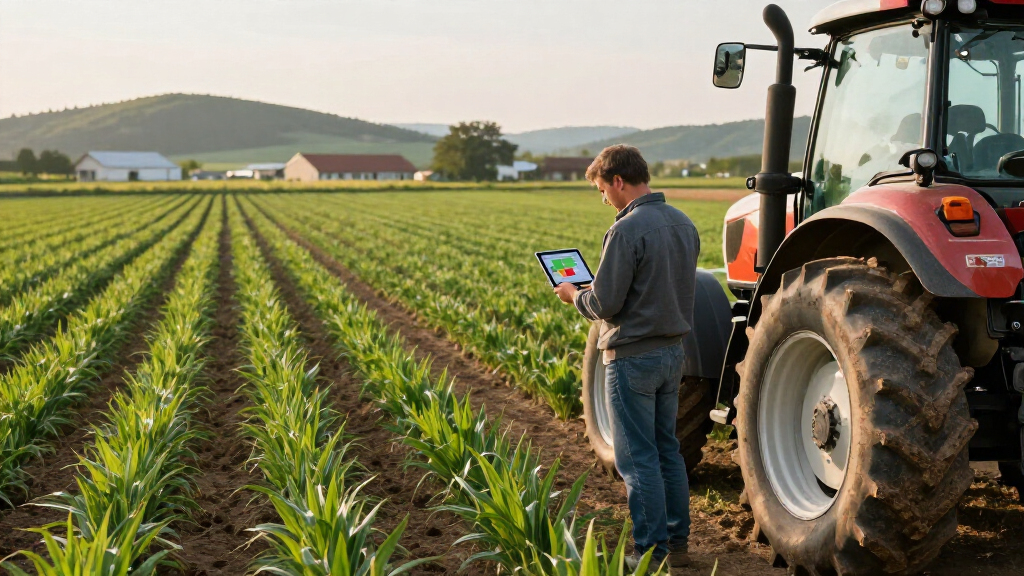
Farm automation is advancing unevenly: satellite-guided tractors and robotic milking systems are established on some farms, while strawberry harvesting remains largely dependent on people. A November 29 report from ThorstenMeyerAI.com uses U.S. and German data to show that adoption is concentrated in larger operations and that the spread of farm technology does not mean most farms use it.
U.S. Department of Agriculture data show that automatic steering was used on 5.3% of planted corn acres in 2001, rising to 58% in 2016. By 2019, guidance systems were used on more than half of the acres planted to corn, soybeans, winter wheat and cotton, although the figures come from different crop years. These systems help guide farm machinery; the figures do not show that every guided machine uses AI.
Adoption looks less widespread when counted by farm rather than by acreage. The USDA reported that 22% of U.S. farms used at least one precision agriculture practice in 2025, down from 27% in 2023. The category includes more than satellite guidance: it can include yield monitoring, soil mapping, variable-rate applications, drones, electronic livestock tags, precision feeding and robotic milking. The report says large farms adopt these tools more often: in 2016, guidance was used by 73% of the largest corn farms, compared with 10% of the smallest.
Automation has also entered dairy barns. Germany’s statistics office, Destatis, counted 8,800 dairy farms using automatic milking systems in 2023, equal to 19% of the country’s 46,600 dairy farms. In these systems, a cow enters a milking station and sensors and a robotic arm position the equipment. The figures describe automated milking, not a measure of AI use specifically.
Soft-fruit harvesting remains a tougher problem. A 2024 University of California cost study cited in the report found that harvesting accounted for about two-thirds of costs in organic strawberry production. A review published in 2014, covering 50 harvesting robots developed over three decades, reported a 66% average picking success rate and 33 seconds per fruit; it found no robot then on the market. The report says commercial strawberry robots now operate on table-top growing systems, rather than in fields where fruit grows close to the ground.
Infographic 01 · Precision farming
Most acres, not most farms
Satellite steering took over most of America’s big crop fields, but only about one US farm in five uses any precision farming. The big farms adopt first.
US corn · share of planted acres with auto-steer (ERS, ARMS)
Guidance systems by 2019 · share of planted acres (ERS)
US farms using any precision agriculture practice · share of farms (NASS)
US corn farms using guidance, 2016 · by farm size (ERS)
Germany, 2023 · dairy farms with milking robots (Destatis)
Acre shares (ERS, by crop and survey year) and farm shares (NASS) are different measures and not directly comparable. Before 2018, ERS “guidance” means auto-steer without lightbars. NASS counts GPS guidance, yield monitoring, soil mapping, variable rate, drones, electronic tagging, precision feeding and robotic milking.
Sources: USDA ERS, EIB-248 (2023); USDA ERS, Amber Waves (April 2023); USDA NASS, Technology Use (August 2025); Destatis press release 204 (23 May 2024).
Powered by Thorsten Meyer AI
Why Farm Automation Reaches Some Tasks First
The figures show that automation is not arriving across agriculture as one uniform change. Guidance can be applied across large areas and is especially common on bigger farms, while individual fruit still has to be located, assessed for ripeness and handled without damage. A technology that works on a broad field task does not automatically solve the more delicate work of harvesting produce.
That difference matters for farm workers and food production. Strawberry picking is labor-intensive, and the report cites a 2024 study in which harvest made up about two-thirds of costs for organic strawberries. If reliable field-harvesting systems become practical, they could change how growers organize this work. But the cited material does not measure any such effects, and it does not show that current robots can replace human pickers at scale.
Farm-level adoption figures also complicate claims that agriculture is already automated. Technology can cover a large share of acres while being used by a minority of farms, because larger operations manage more land and are more likely to adopt equipment. The reported decline in the share of farms using any precision practice, from 27% in 2023 to 22% in 2025, also cautions against treating adoption as a steady or universal march.
Popular right now

Ninja CREAMi 7-in-1 Ice Cream Maker, NC299AMZ

Bose QuietComfort Wireless Noise-Cancelling Headphones, Sandstone

Sony WH-1000XM4C Wireless Noise-Cancelling Headphones, Black
As an affiliate, we earn on qualifying purchases.
From GPS Guidance to Robotic Milking
The report traces precision agriculture to equipment that measures and adjusts farm operations. According to the USDA Economic Research Service, yield monitors reached the market in 1993, followed by yield and soil maps. Variable-rate technology, introduced in 1995, lets machines alter the amount of seed, fertilizer or lime applied in different parts of a field. Guidance systems developed from driver-assistance lights in the mid-1990s to automatic steering in the late 1990s.
A key change for satellite-guided equipment came on May 1, 2000, when the U.S. government ended the deliberate degradation of civilian GPS signals. The report links more accurate positioning with the later spread of guidance systems. It also notes that dairy automation developed along a separate path: Dutch company Lely says it installed a prototype milking robot on two farms in 1992 and launched the system commercially in 1995.
The examples span different kinds of technology and should not all be labeled AI. GPS guidance, automated feeding and robotic milking involve sensors and machinery, but the material does not specify which systems use AI models. Its central comparison is about what farm equipment can do and how widely it is used, not a census of AI deployments.
“Most acres, not most farms.”
— Thorsten Meyer, ThorstenMeyerAI.com
How Far Field Robots Can Scale
The source material does not give a current, nationwide count of farms using AI systems, nor does it separate AI software from other forms of automation. Its adoption statistics cover broad categories of precision agriculture and are drawn from different years and measures, so they cannot establish a single rate of AI use across agriculture.
It is also unclear how many strawberry-picking robots are working commercially, how much fruit they harvest, or whether they are economically viable beyond table-top growing systems. The report describes commercial use in those systems but offers no deployment totals, performance data or comparison with field labor. The USDA figures cited here do not explain why reported precision-practice use fell from 27% of farms in 2023 to 22% in 2025.
Evidence to Watch in Future Data
The next useful evidence will be comparable updates on farm technology adoption, including separate figures for specific tools, farm sizes and acreage. That would help show whether the 2025 decline in the share of U.S. farms reporting precision practices reflects a lasting pattern or a change in survey results, technology use or farm composition.
For strawberry automation, the key test is whether commercial systems move beyond table-top production into field conditions while demonstrating reliable picking speed and performance. The source report does not give a timetable for that shift. Until further data are available, the picture remains mixed: machines can guide tractors and milk cows, but the reach of robots into field harvesting is still uncertain.
Key Questions
Are most farms already using precision agriculture?
No. The USDA reported that 22% of U.S. farms used at least one precision agriculture practice in 2025. A larger share of some crop acreage uses guidance systems, in part because large farms account for more land and adopt the technology more often.
Does the report show that AI is used on most farms?
No. The cited figures cover precision agriculture and automation, such as GPS guidance and robotic milking. They do not identify which systems use AI or provide a national measure of AI adoption.
Why is strawberry picking difficult to automate?
Picking requires a machine to find individual fruit, judge whether it is ready and handle it without damage. The report says commercial strawberry robots are working on table-top systems, but it does not provide evidence that they can perform the task widely in field conditions.
How common are robotic milkers in Germany?
Destatis counted 8,800 German dairy farms with automatic milking systems in 2023, or 19% of the country’s 46,600 dairy farms.
Source: ThorstenMeyerAI.com