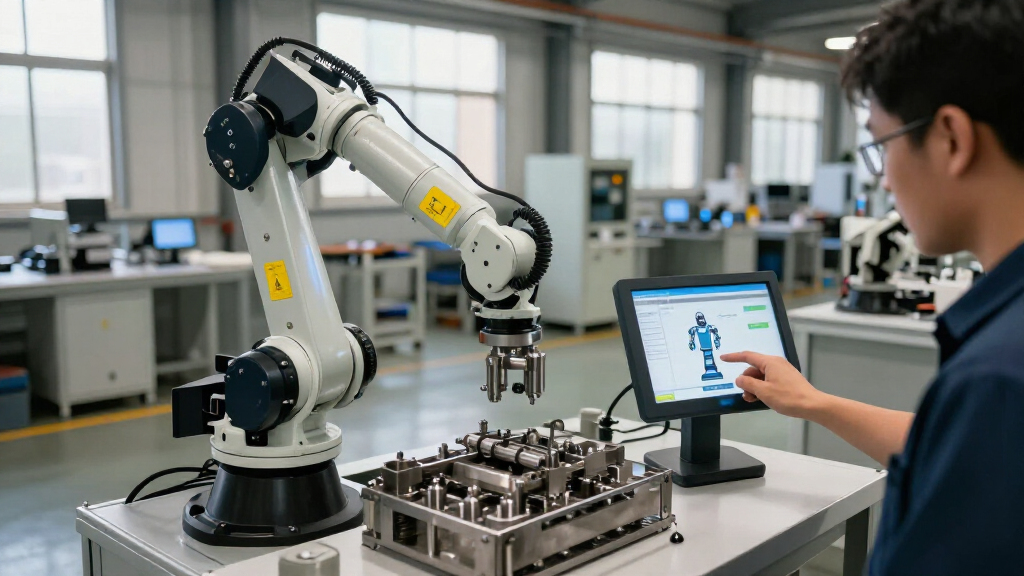
🔍 Read the full analysis: A Simple Guide To AI In Factory Robotics on ThorstenMeyerAI.com

Get smart everyday buys delivered free with Prime
- Fast, free delivery on millions of items
- Prime Video, Amazon Music and more included
- Member-only deals all year
TL;DR
The source reports that five million industrial robots were operating worldwide in 2025, with China accounting for 59% of new installations. Research it cites finds different employment effects in the United States and Germany; it does not provide evidence that AI itself caused the reported growth or job outcomes.
A November 24 report on factory robotics says the number of industrial robots operating worldwide reached 5 million in 2025, while research on their employment effects points to different outcomes in the United States and Germany. The figures describe industrial robots broadly; the source does not establish what share use artificial intelligence or whether AI drove the latest installations, a distinction explored in explanations of deep learning.
The report, published by ThorstenMeyerAI.com, attributes the global robot count to the International Federation of Robotics (IFR). It says factories installed more than 600,000 robots in 2025, and that the operating stock was 9% higher than in 2024 and more than double its level seven years earlier. China accounted for 354,000 installations, or 59% of the year’s total, according to the report’s account of IFR data.
The source describes industrial robots as machines introduced to take on demanding production tasks, part of the broader debate around factory robotics. It traces their use to Unimate, which began unloading a die-casting press at a General Motors plant in Trenton, New Jersey, in 1961. Robots later moved into welding and other factory work. These examples establish the history of industrial automation, but the report does not say that the early machines used AI.
For employment, the report cites a study by economists Daron Acemoglu and Pascual Restrepo, published in 2020. It says their estimate for the United States was that each additional industrial robot between 1990 and 2007 displaced about 3.3 workers across the economy, with an estimated total of about 400,000 jobs. The report contrasts this with Germany, where it says research found factory job losses were offset by roughly equivalent job gains in services. Those estimates cover particular places and periods, not every factory or today’s AI systems.
Infographic 01 · Five million robots
Where the robots work
Sixty-five years after the first Unimate, five million industrial robots work in the world's factories. South Korea has by far the most per worker.
Robots per 10,000 employees in manufacturing · 2024
Where the new robots went · 2025
- China: 354,000 installed, 59% of the world total.
- United States: almost 38,500 (+12%), again the second-largest market.
- Japan 36,219 (−19%) · South Korea 30,000 · Germany fewer than 25,000 (−8%), Europe’s largest market.
Robot density = operational industrial robots per 10,000 employees in manufacturing. China (166 in 2024) is not compared here: the IFR switched to updated Chinese labour data in 2026, which changed the denominator.
Sources: IFR, robot density press release, 8 Apr 2026 (data 2024); IFR, World Robotics 2026 press release, 24 Sep 2026.
Powered by Thorsten Meyer AI
Automation’s Uneven Employment Effects
The figures matter to workers and manufacturers because they show that robot adoption is both widespread and geographically concentrated. China’s 59% share of new installations in 2025 indicates how strongly deployment is centered in one market, while the report’s robot-density figures show that adoption per manufacturing employee varies sharply among countries.
The employment evidence is not a simple verdict that robots either eliminate or create jobs. The U.S. estimate concerns workers displaced over 1990–2007; the German comparison describes factory losses alongside service-sector gains. Outcomes can differ depending on the period, industry, local labor market and whether researchers count only factory jobs or employment across the wider economy. The source also cautions that effects can differ between workers who held factory jobs and people who never entered those jobs.
For readers asking specifically about AI in factory robotics, an important limit is that robot counts do not identify a machine’s software or capabilities. A factory robot may perform programmed movements without the source showing that it uses AI. The numbers therefore describe automation, not an independently measured effect of AI.
Popular right now

Bose QuietComfort Wireless Noise Cancelling Headphones, Ice Blue

Philips 3300 Series Fully Automatic Espresso Machine with LatteGo

Ninja Foodi Smart 6-in-1 Indoor Grill and Air Fryer, 4 Qt, FG551
As an affiliate, we earn on qualifying purchases.
From Unimate to Global Installations
The report dates the technology’s early history to George C. Devol’s 1954 patent application for a programmed article-transfer machine. Devol and entrepreneur Joseph Engelberger founded Unimation, and the company’s Unimate was installed at General Motors’ Trenton plant in 1961. The IFR and The Henry Ford museum are cited in the source for the machine’s role unloading a die-casting press.
Industrial robots then expanded into welding. The report says GM installed Unimate spot-welding robots at its Lordstown, Ohio, plant in 1969. Citing IFR, it says the change allowed more than 90% of body welding to be automated there, compared with 20% to 40% at traditional plants. Japan’s Kawasaki began producing a licensed Unimate in 1969, according to the company history cited by the report, amid demand for workers in hard, dirty and dangerous jobs.
For a country-to-country comparison, the source cites IFR robot-density data for 2024, published in April 2026. South Korea led with 1,220 robots per 10,000 manufacturing employees, followed by Singapore at 818, Germany at 449 and Japan at 446. The United States ranked eighth at 307; the world average was 132. These figures measure robot density, not the proportion of workers replaced or the amount of AI in use.
““More robots mean fewer jobs” is partly true.”
— ThorstenMeyerAI.com report, summarizing the employment evidence
What Robot Counts Cannot Tell Us
The source does not give a breakdown of how many robots in the reported global total use AI, what kinds of AI they use, or how AI features affect productivity and staffing. It also does not supply a detailed account of the underlying German employment study, so readers cannot compare its methods directly with the cited U.S. research from this material alone.
The employment estimates are historical: the U.S. figure covers 1990–2007, and the article was published in 2026. They do not establish what happened to employment in 2025, how current AI-enabled systems affect particular occupations, or what the long-term effects will be. The source also does not identify the methods or uncertainty ranges behind the job estimates in the supplied material.
The Next Evidence to Watch
The next useful evidence would separate conventional industrial robots from systems with AI capabilities, and report how each is used, what tasks change and what happens to workers afterward. Comparable studies would need to track both factory and service employment over time rather than treat robot installations alone as a measure of job losses.
The report provides no specific future release date for new employment research or robot data. For now, its clearest benchmarks are the IFR’s 2025 installation and operating-stock figures and its 2024 robot-density comparisons. Any claims about AI’s distinct contribution should await data that measure AI use directly.
Key Questions
How many industrial robots were operating worldwide in 2025?
The report says the International Federation of Robotics counted 5 million industrial robots in operation worldwide in 2025, 9% more than in 2024.
Does the five-million figure count only AI-powered robots?
No such breakdown is provided. The figure covers industrial robots generally, and the source does not state how many use AI.
Does the report show that robots always reduce employment?
No. It cites an estimate of job displacement in the United States for 1990–2007 and a different German pattern in which service-sector gains roughly offset factory job losses. The findings relate to specific settings and periods.
Which country installed the most industrial robots in 2025?
China, with 354,000 installations, equal to 59% of the global total reported for that year.
What remains unknown about AI and factory jobs?
The source does not measure AI use among the robots counted or isolate AI’s effect on jobs. It also offers no current employment estimate covering the 2025 robot installations.
Source: ThorstenMeyerAI.com