📊 Full opportunity report: A Clearer Look At GLP-1 Availability And Out-of-Pocket Costs on IdeaNavigator AI — validation score, market gap, and execution plan.

Get smart everyday buys delivered free with Prime
- Fast, free delivery on millions of items
- Prime Video, Amazon Music and more included
- Member-only deals all year
TL;DR
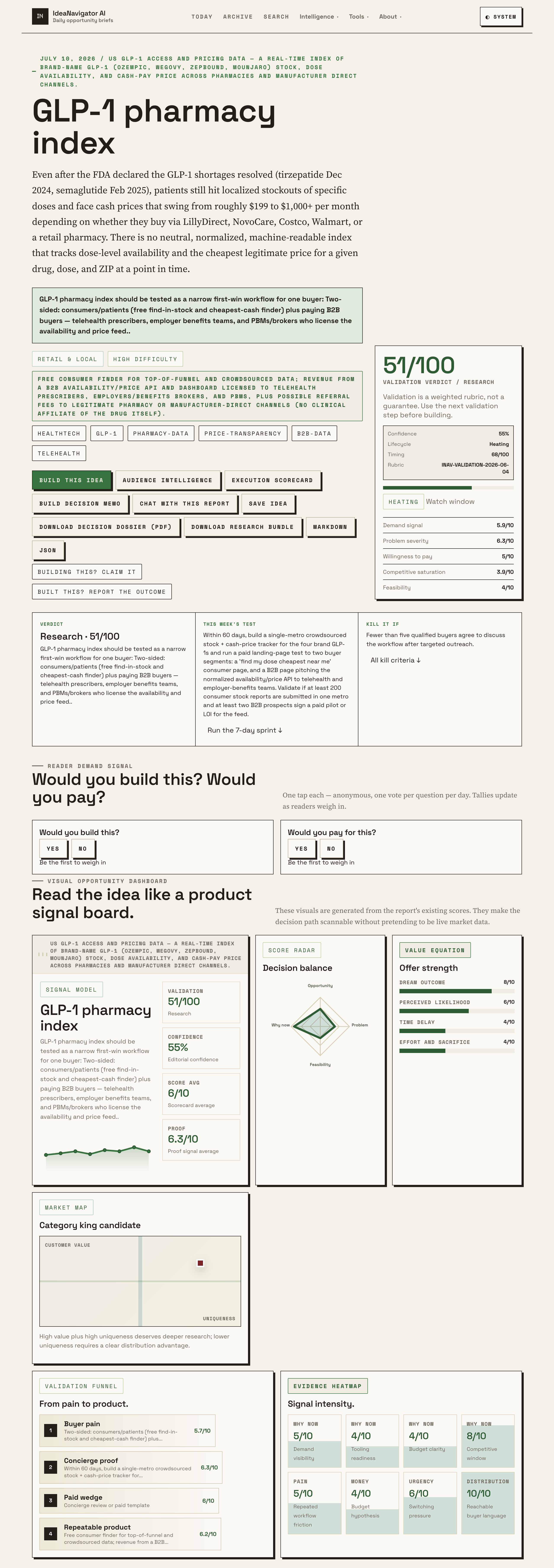
A new analysis from IdeaNavigator AI outlines why US GLP-1 access has shifted from a shortage problem to a fragmentation problem: brand drugs are off the FDA shortage list, yet dose-level stockouts persist and cash prices range from roughly $199 to more than $1,000 per month. It proposes a two-sided pharmacy index that tracks dose-level availability and the cheapest cash price, free for consumers and licensed as a data feed to telehealth, employer, and PBM buyers.
The end of official GLP-1 shortages has not ended access problems for US patients, according to an analysis by IdeaNavigator AI. Even though the FDA declared the tirzepatide shortage resolved in December 2024 and the semaglutide shortage resolved in February 2025, patients continue to encounter localized stockouts of specific doses and cash prices that swing from roughly $199 to more than $1,000 per month depending on where they buy. The analysis proposes a neutral, machine-readable index of dose-level availability and cheapest cash prices as a fix — and identifies employers, now reporting GLP-1s at roughly 20% of pharmacy spend, as the buyers most in need of the data.
The analysis identifies a structural gap: no neutral source currently normalizes dose-level availability and the cheapest legitimate cash price for a given drug, dose, and ZIP code at a point in time. The four brand-name drugs in scope are Ozempic, Wegovy, Zepbound, and Mounjaro. Prices vary sharply across channels including LillyDirect, NovoCare, Costco, Walmart, retail pharmacies, and the TrumpRx portal launched in February 2026. A patient searching for one specific dose may find it unavailable nearby while a different dose is in stock, and the same prescription can carry a dramatically different cash price depending on which channel is used.
The proposed product is two-sided. Consumers would get a free web tool that shows, by drug + dose + ZIP code, which pharmacies have stock and which legitimate channel offers the cheapest cash price. The initial data would come from crowdsourced stock reports combined with normalized public pricing from manufacturer direct sites, Costco and Walmart cash programs, and a GoodRx-style price layer. Dose-level availability alerts would sit on top.
Revenue would come from the business side: a B2B availability and price API and dashboard licensed to telehealth prescribers, employer benefits teams and brokers, and PBMs, with possible referral fees to legitimate pharmacy or manufacturer-direct channels. The proposed validation plan calls for a single-metro crowdsourced tracker and paid landing-page tests within 60 days, with success defined as at least 200 consumer stock reports in one metro and at least two B2B paid pilots or letters of intent for the feed.
Why Price Fragmentation Hits Patients and Employers
The analysis argues the market has moved from a shortage problem to a fragmentation problem. When the FDA shortage listings ended, compounding deadlines forced many compounders out of the market at the same time manufacturers launched competing direct cash-pay channels. That combination produced a sprawl of prices and dose-level supply gaps that no single source tracks in normalized form — leaving patients to check multiple sites manually and employers without data to steer costs.
For employers and benefits teams, the stakes are financial. According to the analysis, employers report GLP-1s now account for roughly 20% of pharmacy spend, and cost-steering decisions — which channel to point members toward — depend on price and availability data that currently has to be assembled by hand. A licensed feed would give telehealth prescribers and PBMs a real-time view of what a specific dose actually costs and where it is actually in stock, rather than relying on static formulary data or anecdote.
From Shortage Declarations to Competing Cash Channels
The GLP-1 supply picture changed in stages. The FDA declared the tirzepatide shortage resolved in December 2024 and the semaglutide shortage resolved in February 2025, which removed the regulatory basis for much compounded production as enforcement deadlines for compounders took effect. In parallel, manufacturers built out direct-to-patient cash channels: Lilly’s LillyDirect and Novo Nordisk’s NovoCare sell brand drugs at cash prices that often undercut insured cost-sharing, while Costco and Walmart run their own cash programs. The launch of the TrumpRx portal in February 2026 added another public channel. The result, per the analysis, is that a patient’s out-of-pocket cost depends heavily on which of these channels they know about and can access — a gap the proposed index is designed to close.
What the Price Range Does and Doesn’t Show
The $199-to-$1,000+ price range is presented as a rough monthly cash-price span across channels, not a controlled comparison of identical prescriptions — the analysis does not specify which drug and dose combinations sit at each end, or the time window over which those prices were observed. The claim that GLP-1s represent roughly 20% of employer pharmacy spend is attributed to employer reporting without a named survey or sample size. The localized stockouts are described as ongoing but not quantified by metro or frequency.
The proposal itself is also unvalidated: the crowdsourced stock-report model, the accuracy of consumer-submitted availability data, and whether B2B buyers will pay for the feed have not been tested. The analysis sets out validation thresholds — 200 consumer reports in one metro and two signed B2B pilots — but these are targets, not results. Whether crowdsourced data can stay current enough to be reliable at dose level remains an open question.
Testing the Index in One Metro
Under the proposed plan, the next step is a 60-day single-metro pilot: build a crowdsourced stock and cash-price tracker for the four brand GLP-1s and run paid landing-page tests aimed at two audiences — consumers via a “find my dose cheapest near me” page, and B2B prospects via a pitch page for the normalized availability and price API. If the pilot hits its thresholds, the next phase would add dose-level availability alerts and onboard one or two design partners among telehealth prescribers or employer-benefits teams. Nothing has been built yet; the concept remains at the idea-validation stage, and no consumer tool or B2B feed is currently live.
Key Questions
Are GLP-1s still in shortage?
No. The FDA declared the tirzepatide shortage resolved in December 2024 and the semaglutide shortage resolved in February 2025. However, per the IdeaNavigator AI analysis, patients still encounter localized stockouts of specific doses at individual pharmacies, which is different from a formal national shortage.
Why do GLP-1 cash prices vary so much?
Prices differ across channels — LillyDirect, NovoCare, Costco, Walmart cash programs, retail pharmacies, and the TrumpRx portal launched in February 2026. The analysis reports a span of roughly $199 to over $1,000 per month, though it does not specify which drug and dose combinations define each end of that range.
What would the proposed GLP-1 pharmacy index do?
It would let consumers search by drug, dose, and ZIP code to find which pharmacies have stock and which legitimate channel offers the cheapest cash price. The same normalized availability and price data would be licensed as a B2B API to telehealth prescribers, employer benefits teams, and PBMs.
Does a tool like this exist today?
Not in the form described. According to the analysis, no neutral, machine-readable index currently tracks dose-level availability and the cheapest cash price by ZIP code. Existing price tools and manufacturer direct sites each cover only part of the picture, and the proposed index is still at the idea-validation stage with nothing built.
How would the index know what is actually in stock?
The proposed model relies primarily on crowdsourced consumer stock reports, supplemented by normalized public pricing data from manufacturer sites and retail cash programs. Its reliability depends on submission volume and freshness — one of the untested assumptions the planned single-metro pilot is designed to check.
Source: IdeaNavigator AI
Halloween Picks
halloween
As an affiliate, we earn on qualifying purchases.