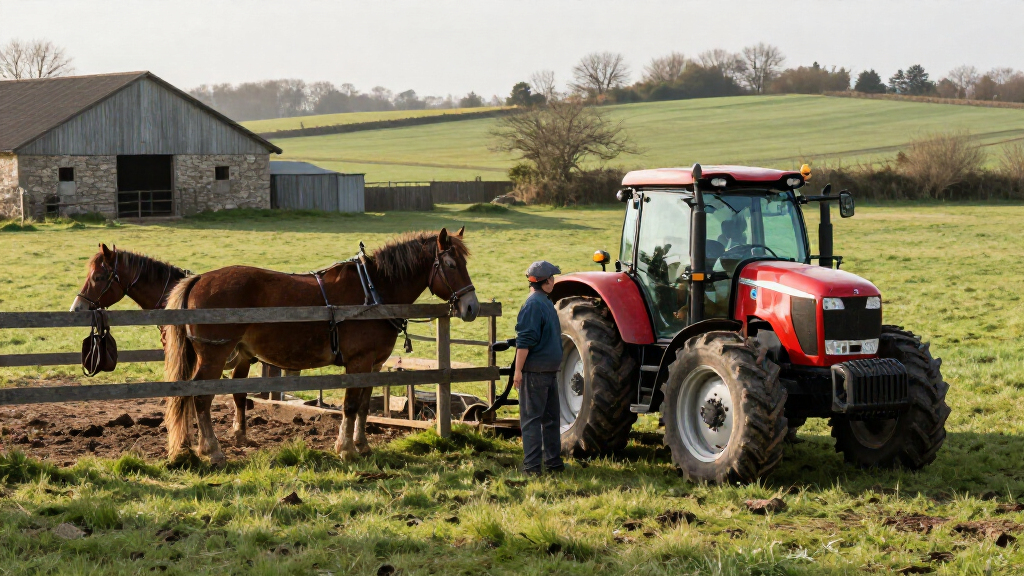

🔍 Read the full analysis: What Did Tractors Mean For Millions Of Working Animals? on ThorstenMeyerAI.com

Get smart everyday buys delivered free with Prime
- Fast, free delivery on millions of items
- Prime Video, Amazon Music and more included
- Member-only deals all year
TL;DR
U.S. farm horses and mules peaked at 26.7 million in 1918, then declined to 3.1 million by 1960 as tractors and other machinery took over agricultural work. The shift freed land used to grow animal feed and accompanied a sharp fall in farm employment, but the animal-to-machine story is an analogy—not a rule for what automation will do to human workers.
U.S. farm horses and mules fell from a peak of 26.7 million in 1918 to 3.1 million in 1960 as tractors and other machinery took over work once done by animals. A November 4 report from ThorstenMeyerAI.com uses that change to examine the scale of agricultural automation and the limits of comparing displaced animals with human workers.
Historical estimates reproduced in the U.S. Census Bureau’s Historical Statistics of the United States, Colonial Times to 1970 put the combined number of horses and mules on farms at 26.7 million on January 1, 1918. Horses alone peaked earlier, at 21.4 million in 1915. In 1960, the combined farm-animal count was 3.1 million—a decline of almost 90% from the 1918 peak.
The animals required land and feed even when they were not working. The report says about 93 million acres of harvested cropland were used to grow feed for horses and mules in 1915, out of 340 million harvested acres. That was more than a quarter of the total. By 1960, the area devoted to their feed had fallen to about 5 million acres, according to the source material.
Tractor adoption accelerated over the same decades. The reported count rose from about 1,000 tractors on U.S. farms in 1910 to 246,000 in 1920 and 4.69 million in 1960. Around 1955, tractors outnumbered horses and mules for the first time, with the source giving counts of 4.35 million tractors and 4.31 million animals. Combine harvesters and other equipment also spread, alongside changes including fertilizer and improved seed.
Land and Labor After the Horse
The substitution changed more than how farmers pulled equipment. As fewer acres were needed to feed working animals, that land could be used for other crops. The report describes this as a hidden dividend of mechanization, though it does not quantify the economic value of the land released or show how gains were distributed among farmers and consumers.
Farm work also contracted. The source reports that U.S. farm employment peaked at 13.6 million in 1916 and had fallen to 4.5 million by 1970, while the overall U.S. labor force doubled. It says new employment grew in cities, requiring many people to move. These figures place machinery within a broader economic transformation; they do not establish that tractors alone caused the full decline in farm employment.
The history is often invoked in debates about whether machines will displace human workers. The report points to economist Wassily Leontief’s 1983 comparison between workers and horses replaced by tractors, but also notes a central difference: horses could not vote. People can influence policy and institutions, and the conditions surrounding technological change differ across industries and eras.
Popular right now

Hisense 65-inch U6 Pro Mini-LED 4K UHD Smart Fire TV

TCL 65 Inch QM8L Series SQD-Mini LED QLED 4K Smart Google TV

TCL 65-Inch T7 Series 4K QLED Smart Google TV, 144Hz (65T7)
As an affiliate, we earn on qualifying purchases.
How Farm Tractors Spread
Tractors existed before World War I, but the source says early gasoline models were heavy, expensive and better suited to large farms. Ford introduced the Fordson in 1917. The Henry Ford museum describes it as “the first mass-produced and inexpensive lightweight tractor,” designed for small farmers, and says it “rapidly became the most popular tractor in America.” The 100,000th Fordson left the assembly line on February 21, 1920.
Tractors were part of a wider package of farm technologies. The report gives U.S. combine harvester counts of about 4,000 in 1920, 190,000 in 1940 and 1.042 million in 1960. It also says the U.S. Department of Agriculture estimated that one farm worker supplied 7.1 people with farm products in 1910 and 47.1 in 1970; the latter figure includes people abroad supplied through exports. These measures describe increasing output per worker, not a direct count of jobs lost to any one machine.
The report also mentions more recent and international examples, including mechanization in China and autonomy equipment for some tractors. Those developments show that agricultural automation continues, but they do not mean today’s machines perform every farm task or reproduce the same conditions as the earlier transition.
Where the Horse Analogy Breaks
The historical figures document the decline in farm horses and mules and the rise in tractor counts, but they do not isolate the effect of tractors from other changes in agriculture. Farm employment also reflects broader economic shifts, including movement of jobs to cities; the source does not provide a causal breakdown of how much machinery contributed to the decline.
The source says farmers generally stopped breeding replacements as working animals aged out, rather than describing a single mass event. It does not provide a detailed account of what happened to every animal, or how outcomes differed by region and use. Its international references to China, Germany and Japan are not accompanied here by comparable time series, so the scale and timing of those countries’ changes cannot be assessed from the supplied material.
Current automation also has limits. The report says John Deere’s 16-camera autonomy kit, announced in February 2025, is used for tillage on select large tractors. It also attributes to China a figure of about 74% mechanization for ploughing, sowing and harvesting in 2023, without giving a detailed definition or comparison baseline. Neither figure establishes that farms are fully autonomous or that human farm work has been eliminated.
What Today’s Farm Robots Can Do
The next developments to watch are the spread of autonomous equipment beyond select large tractors and whether it can handle a broader range of farm tasks. The source does not give a timetable for wider deployment or say how many farms currently use the cited John Deere system, so adoption levels and near-term effects on agricultural jobs remain uncertain.
For readers comparing past and present automation, the historical record offers measurable changes in animal numbers, machinery, land use and farm employment. It cannot, on its own, predict how human work will change. Any stronger conclusion would require current evidence on where machines are being adopted, which tasks they replace, what new work they create and how workers and communities adapt.
Key Questions
How many horses and mules worked on U.S. farms at the peak?
The historical estimates cited in the report put the combined total at 26.7 million on January 1, 1918. Horses alone had peaked at 21.4 million in 1915.
How many farm horses and mules remained in 1960?
The reported count was 3.1 million in 1960, almost 90% below the combined 1918 peak.
Why did tractors replace working animals?
Tractors took over many tasks previously done by horses and mules, while animals required feed throughout the year. The source says more than a quarter of U.S. harvested cropland was used to grow their feed in 1915. It describes tractors as part of a larger shift that also included combines and other farm technologies.
What happened to the horses and mules?
The report says farmers stopped breeding replacements and the working population aged out. It does not provide a detailed account of the fate of individual animals or how outcomes varied.
Does the horse-to-tractor shift predict what AI will do to human jobs?
No. The report presents it as an analogy, not a law. Human workers differ from working animals in their ability to change jobs, organize and influence policy, and the effects of modern automation depend on evidence about specific industries and tasks.
Source: ThorstenMeyerAI.com