
📊 Full opportunity report: Can Govtech Help Match Businesses With Local Commercial Space? on IdeaNavigator AI — validation score, market gap, and execution plan.

Get smart everyday buys delivered free with Prime
- Fast, free delivery on millions of items
- Prime Video, Amazon Music and more included
- Member-only deals all year
TL;DR
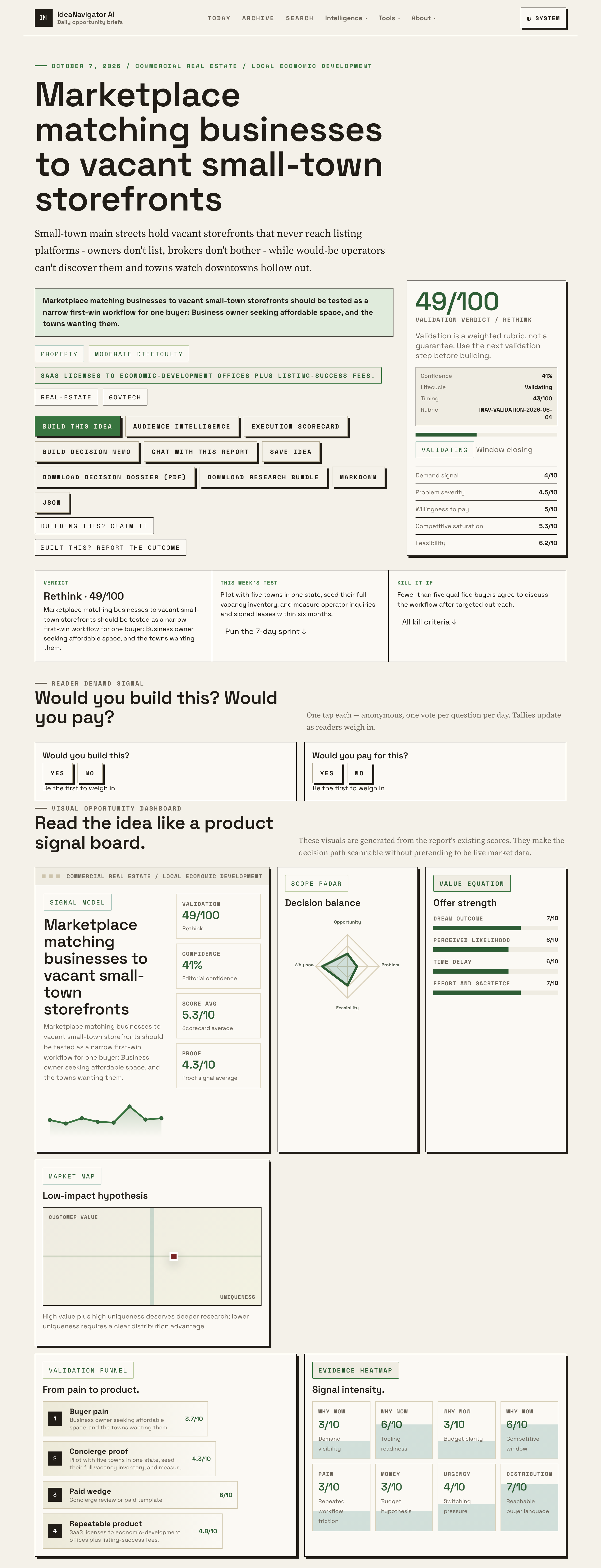
A proposal calls for testing a marketplace that connects businesses with vacant small-town storefronts and routes matches to local economic-development offices. The suggested pilot would cover five towns in one state and track inquiries and signed leases over six months; no pilot results or evidence of demand are provided yet.
IdeaNavigator AI has proposed a small-town storefront marketplace that would connect business operators seeking affordable commercial space with property owners and local economic-development offices. The concept is a suggested pilot, not a reported launch: its proposed test would involve five towns in one state and measure inquiries and signed leases over six months.
The proposed service would let towns and property owners post vacant storefronts with photos, size, rent and available incentives. Business operators could browse listings by town profile and foot-traffic data. When an operator expresses interest, the marketplace would route the match to the local development office, with relevant grants attached where available.
The stated problem is that some small-town commercial vacancies do not appear on established listing platforms. Owners may not list their properties, and brokers may not pursue them, leaving potential operators with limited ways to find spaces. The proposal links this information gap to empty main-street storefronts, but it does not quantify vacancies or establish how often businesses fail to find space because listings are unavailable.
The suggested business model combines software licenses for economic-development offices with fees tied to successful listings. To test demand, the proposal recommends entering the full vacancy inventory for five towns in one state, then tracking operator inquiries and signed leases during the following six months. No participating towns, funding commitments, product, or results are identified.
How a Match Could Support Main Streets
If the marketplace works as proposed, it could make otherwise hard-to-find commercial spaces easier for prospective operators to discover and give towns a shared process for connecting applicants with property owners. Routing inquiries through local development offices may also help officials identify where grants or other incentives could be relevant. Those are possible benefits of the design, not outcomes demonstrated by a live service.
For towns, filling a vacant storefront can put a property back into use and add a potential business to a commercial district. For operators, a centralized inventory could reduce the effort required to search across owners and municipalities. The proposal matters because it frames a local economic-development task as a testable digital workflow, with leases—not merely website visits—as an intended measure of performance.
The commercial case is also unresolved. Towns would need to see enough useful inquiries and completed leases to justify software costs, while operators and owners would need to keep listings accurate and current. A marketplace with incomplete inventory or little local participation could fail to generate useful matches even if its software functions properly.
Popular right now

Dyson Car+Boat Cordless Handheld Vacuum

Breville Bambino Espresso Machine, Brushed Stainless Steel (BES450BSS)

Samsung 85-Inch QN70H Neo QLED 4K Smart TV (2026)
As an affiliate, we earn on qualifying purchases.
The Proposed Pilot and Its Scope
The idea is presented as a narrow first use case for government technology: serve one primary buyer group, the business owner looking for affordable space, while addressing towns’ interest in attracting businesses. Rather than beginning with a broad commercial-property platform, the suggested approach focuses on small-town storefronts and local economic-development offices.
The proposal cites renewed interest in small-town commercial space associated with remote-work migration and says economic-development offices have access to grants for matching efforts. It provides no data on migration, grant availability, or how many offices have funding that could support such a project. Those points are the rationale offered for testing the idea, rather than independently measured findings.
The proposed six-month evaluation would ask whether operators contact towns about listed spaces and whether those inquiries result in signed leases. Those measures could offer an initial indication of activity, but they would not by themselves show whether the marketplace caused a lease, whether the business remains open, or whether the model can support ongoing costs. The plan does not specify a comparison group or additional measures.
Demand, Funding and Results Remain Open
No operating marketplace or pilot results are described. The proposal does not name participating towns, identify a launch date, provide a budget, or say which organization would build or run the service. It also does not establish whether economic-development offices have committed grant funding for this specific use.
Several design and measurement questions remain unanswered. The plan does not say how owners’ listings would be verified or updated, how foot-traffic data would be gathered, what qualifies as a successful listing, or how fees would be calculated. It also gives no baseline for current inquiries or leases, making it difficult to judge what level of change a pilot would represent.
It is not yet clear how many storefronts are missing from existing platforms or whether owners and operators would use a dedicated marketplace. The proposal identifies a potential gap, but supplies no interviews, adoption data, lease figures, or cost estimates to establish its scale.
A Five-Town Test Would Set the Next Step
The next step proposed is to recruit five towns in one state, assemble a complete inventory of their vacant storefronts, and make listings available to prospective operators. Local offices would need to decide how to handle incoming matches and connect eligible businesses with any available grants.
Over six months, organizers would track inquiries and signed leases, as the proposal recommends. To interpret those figures, a pilot would also need to define its starting point, verify whether leases followed marketplace introductions, and record the costs of collecting listings and operating the service. No timetable or decision on whether to proceed has been announced.
Whether the concept moves beyond a proposal will depend on town participation, property-owner cooperation, available funding and evidence that the service produces useful matches. Until a pilot reports results, the marketplace’s effect on storefront occupancy and its potential as a sustainable government-technology product remain unknown.
Source: IdeaNavigator AI
Key Questions
Has the storefront marketplace launched?
No launch is reported. The idea is a proposed marketplace and pilot; no live service or participating towns are identified.
How would the marketplace work?
Towns and owners would post storefront details such as photos, size, rent and incentives. Operators could browse by town profile and foot-traffic data, with interested matches routed to local development offices.
How would the proposal be tested?
It recommends a pilot in five towns in one state, with a full vacancy inventory and measurement of operator inquiries and signed leases over six months.
Who would pay for the service?
The suggested revenue model is software licenses for economic-development offices plus fees tied to successful listings. No prices, contracts or funding commitments are provided.
What evidence is available that it works?
No results are provided. The proposal does not report a pilot, lease outcomes, adoption figures or cost estimates, so its effectiveness remains untested.
Source: IdeaNavigator AI