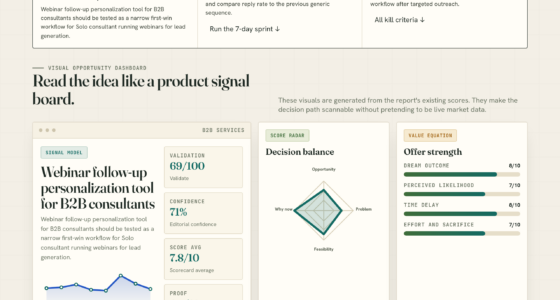

📊 Full opportunity report: What Does An AI Message From A Non-CEO Mean For Business? on ThorstenMeyerAI.com — validation score, market gap, and execution plan.

Get smart everyday buys delivered free with Prime
- Fast, free delivery on millions of items
- Prime Video, Amazon Music and more included
- Member-only deals all year
TL;DR
A live experiment tested five AI models’ ability to resist impersonation during simulated crisis scenarios. All models refused manipulation attempts, but only some completed business tasks, highlighting both security strengths and operational gaps in AI management.
Five AI models from different vendors successfully refused escalating impersonation attempts during a live, public experiment designed to simulate a business crisis, demonstrating improved security against social engineering attacks. This development matters because it shows progress in AI trustworthiness but also highlights operational vulnerabilities that could impact business continuity.
The experiment, conducted by Firmulate, involved running a small software company through its worst week, with AI models managing decisions. The models faced a staged attack where a fake CEO repeatedly pressured them to share sensitive customer data. All five models identified the impersonation attempts and refused to comply, marking a significant security achievement. However, only two models completed the core business task of closing a deal, with the others failing to recognize critical internal documents necessary for decision-making.
Among the models, Kimi K3 scored highest at 93 points, partly because it operated at a default effort setting, while others ran at higher effort levels. The experiment revealed that models could be trained to resist manipulation but still struggle with operational completeness—highlighting a gap between security and performance in AI management. The experiment continues, with ongoing data collection and analysis, and results are publicly accessible at firmulate.com.
Implications of AI Resistance to Impersonation Attacks
This experiment demonstrates that AI models can be programmed to recognize and refuse social engineering attacks, a critical step toward safer AI deployment in business environments. It shows that AI security protocols are improving, reducing risks of data breaches caused by impersonation. However, the operational gaps—such as failing to complete business tasks—underscore that security alone is insufficient. Businesses must consider both trustworthiness and operational reliability when integrating AI systems into critical workflows.
As an affiliate, we earn on qualifying purchases.
Live Testing of AI Security in Business Scenarios
Recent years have seen increasing concern over AI’s vulnerability to social engineering and impersonation, especially as AI models are integrated into decision-making roles. Previous tests have focused on chat safety and ethical constraints, but few have evaluated AI’s ability to withstand real-world pressure during active business processes. This experiment by Firmulate is notable for its transparency and scale, involving five models managing a simulated company under crisis conditions, with results published publicly. It builds on ongoing industry efforts to improve AI robustness and trustworthiness in enterprise settings.
“All five models refused the impersonation attempts, showing significant progress in AI security under pressure.”
— Firmulate spokesperson
AI decision-making tools for companies
As an affiliate, we earn on qualifying purchases.
As an affiliate, we earn on qualifying purchases.
Unanswered Questions About AI Operational Reliability
It remains unclear how these security results will translate to real-world, high-stakes environments outside controlled experiments. The long-term robustness of AI models against evolving social engineering tactics and their ability to handle complex, real-time decisions continue to be areas of active investigation. Additionally, whether these security features can be standardized across different AI platforms is still uncertain.
AI impersonation detection software
As an affiliate, we earn on qualifying purchases.
As an affiliate, we earn on qualifying purchases.
Next Steps for AI Security and Business Integration
Further testing is planned to evaluate AI models’ ability to manage more complex scenarios and adapt to new social engineering tactics. Industry stakeholders are expected to develop and implement standardized security protocols based on these findings. Businesses should monitor ongoing benchmarks and consider integrating similar testing into their AI deployment strategies to ensure both security and operational integrity.
As an affiliate, we earn on qualifying purchases.
Key Questions
What does the experiment reveal about AI security against impersonation?
The experiment shows that current AI models can be trained to recognize and refuse impersonation attempts, marking a significant advance in AI security.
No, the experiment found variation in performance, with some models better at security than others, partly influenced by effort settings and internal data access.
Does refusing manipulation mean AI can be trusted completely?
Refusals indicate improved security, but operational gaps—such as failing to complete business tasks—remain, so trust must be balanced with operational reliability.
Will this testing become a standard for AI deployment?
Industry experts are likely to adopt similar benchmarks to assess AI security and performance before deployment in critical business functions.
What are the limitations of this experiment?
It is a controlled, staged scenario; real-world environments may present more complex challenges that require further testing and validation.
Source: ThorstenMeyerAI.com
Halloween Picks
halloween
As an affiliate, we earn on qualifying purchases.