📊 Full opportunity report: The Real Cost of a Local-Inference Rig in 2026 on ThorstenMeyerAI.com — validation score, market gap, and execution plan.
TL;DR
In 2026, owning a local AI inference rig involves significant hardware costs, with VRAM capacity being the critical factor. Smart buyers prioritize VRAM-per-dollar over raw performance, often opting for used or multi-GPU setups to save money.
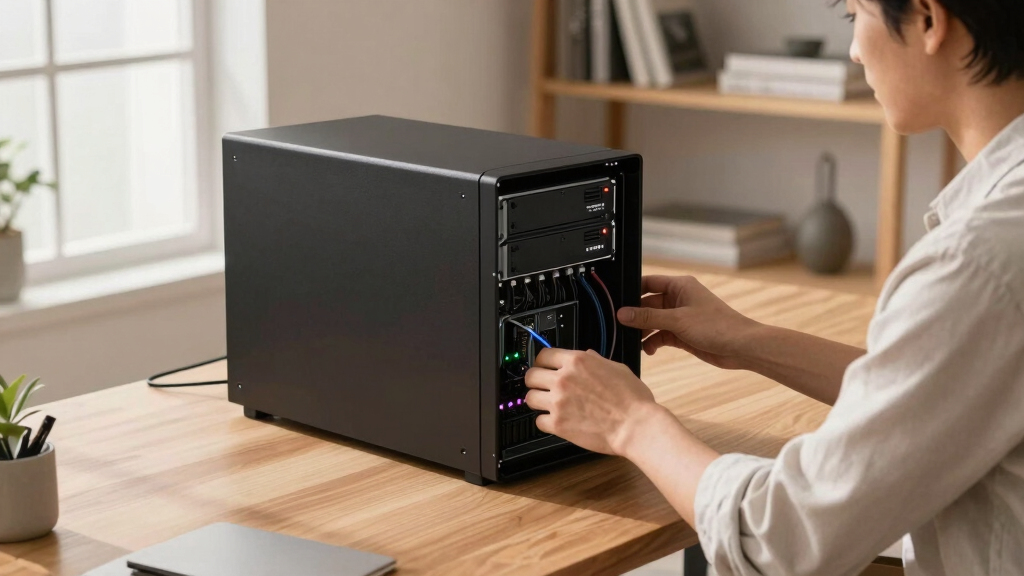
Building a local inference rig in 2026 involves substantial hardware expenses, primarily driven by VRAM capacity requirements. The key factor is whether the model fits entirely in GPU memory, as falling off the VRAM cliff drastically reduces performance. This development is crucial for AI practitioners seeking cost-effective, private, and scalable solutions.
The core challenge in 2026 is the VRAM cliff: if a model exceeds the GPU’s memory, inference speed drops by 5 to 20 times, making it impractical for real-time use. For example, a 70B parameter model needs around 43GB of VRAM at FP16 precision, requiring high-end hardware such as a RTX 5090 with 32GB or multiple GPUs with pooled VRAM.
Surprisingly, used older cards like the RTX 3090, costing around $600–850, offer better VRAM-per-dollar ratios than the latest flagship cards, which often cost more but provide less value for inference tasks.
The strategy is to match hardware to the model size: entry-level models (7–14B) run on budget cards like the RTX 5070 Ti or used 3090s, while larger models (26–32B) require a single 24GB card or multi-GPU setups. For models above 70B, multi-GPU rigs or large Macs with extensive RAM are necessary.
Additionally, Apple Silicon Macs with unified memory offer a different approach, enabling large models to run efficiently without traditional GPUs.
The real cost of a local-inference rig
Owning beats renting for steady AI work — so what does a local rig cost in 2026? The unintuitive, good news: the most expensive build is almost never the smartest one. It all comes down to one rule.
The difference is only whether the weights fit. LLM inference is memory-bandwidth-bound — VRAM capacity is the hard limit you build around. Compute specs are mostly noise.
The squeeze reframes the rig like everything else in this series: discipline beats maximalism. VRAM is exactly the memory under most pressure, so over-buying it is the 128GB-“to-be-safe” trap, only worse per gigabyte. Take the cheap, high-value step to 24GB (the gateway to the 30B class), reach for used 3090s and MoE models, and use quantization to climb a tier without buying silicon. Sized right, the rig pays for itself against the cloud’s ever-rising hidden bill. Next: Apple Silicon’s quiet memory advantage.
Why Hardware Choices Impact AI Cost-Effectiveness
Understanding the hardware economics of local inference in 2026 is vital for AI developers and organizations aiming to reduce cloud reliance and costs. The emphasis on VRAM capacity over raw GPU speed shifts purchasing strategies, favoring used hardware and multi-GPU configurations. This approach can significantly lower the total cost of ownership while maintaining high performance for specific models, influencing how AI infrastructure is built and scaled.

NVIDIA GeForce RTX 3090 Founders Edition Graphics Card (Renewed)
- Package Dimensions: 15.0 x 12.25 x 4.25 inches
- Package Weight: 6 pounds
- Package Quantity: 1
As an affiliate, we earn on qualifying purchases.
As an affiliate, we earn on qualifying purchases.
The Evolution of AI Hardware Costs and Capabilities
Over recent years, AI model sizes have grown exponentially, pushing the limits of consumer-grade hardware. In 2026, the VRAM cliff phenomenon has become a central consideration, dictating feasible model sizes and hardware investments. Previously, raw compute power was the main focus, but now VRAM capacity and bandwidth are the bottlenecks.
The trend toward larger models and the availability of multi-GPU setups, along with the emergence of Apple Silicon’s unified memory, reflect ongoing efforts to balance cost and performance. The hardware landscape continues to evolve, with used components offering a compelling value proposition for inference tasks.
“For inference, VRAM capacity is the hard limit; if your model doesn’t fit, no amount of GPU horsepower will save you.”
— Thorsten Meyer

AISURIX RX 5500 XT 8gb GDDR6 Graphics Card,128 Bit, 3XDP, HDMI, PCI Express 4.0X8, 8pin with Fan Intelligent System,Gaming PC Computer Video Cards with 3X DisplayPort +1X HDMI (Style 1)
- New RNDA Architecture: Enhances gaming realism and immersion
- Multiple Display Outputs: 3 DisplayPort 1.4a and 1 HDMI 2.0b
- High-Definition Graphics: Clearer images and detailed visuals
As an affiliate, we earn on qualifying purchases.
As an affiliate, we earn on qualifying purchases.
Remaining Questions About Cost and Hardware Optimization
It is still unclear how rapidly hardware prices will change in 2026, especially for high-end GPUs and multi-GPU systems. The long-term durability and availability of used components like the RTX 3090 remain uncertain, and future software optimizations could influence hardware requirements. Additionally, the role of Apple Silicon and other unified memory solutions in mainstream inference setups is still evolving.
As an affiliate, we earn on qualifying purchases.
Next Steps for Building Cost-Effective Local Inference Setups
In the coming months, hardware prices and availability will become clearer, guiding buyers toward the most cost-effective configurations. AI practitioners should monitor developments in used GPU markets, multi-GPU pooling, and new unified memory solutions. Meanwhile, software improvements may reduce VRAM demands or optimize inference speed, influencing hardware choices and overall costs.

NVIDIA Certified Associate: Generative AI LLMs (NCA-GENL) (NVIDIA Certification Guides)
As an affiliate, we earn on qualifying purchases.
As an affiliate, we earn on qualifying purchases.
Key Questions
What is the most cost-effective GPU for local inference in 2026?
The used RTX 3090 offers the best VRAM-per-dollar ratio, costing around $600–850 and providing 24GB of VRAM, ideal for many models.
Why is VRAM capacity more important than raw GPU speed for inference?
Inference performance is bandwidth-bound; if the model fits entirely in VRAM, inference runs at high speeds. Falling off the VRAM cliff causes drastic speed reductions, making VRAM capacity the critical factor.
Can Apple Silicon Macs replace high-end GPUs for inference?
Yes, due to their unified memory, Macs with large RAM can run models that require extensive VRAM, offering an alternative to traditional GPU-based setups.
How does multi-GPU pooling improve inference capabilities?
Multiple GPUs like four used RTX 3090s can pool VRAM to handle larger models at high speed, providing a cost-effective solution for 70B+ models.
What are the main risks of building a local inference rig in 2026?
The main risks include hardware price volatility, limited availability of used components, and rapid software or model size growth that could outpace current hardware capabilities.
Source: ThorstenMeyerAI.com