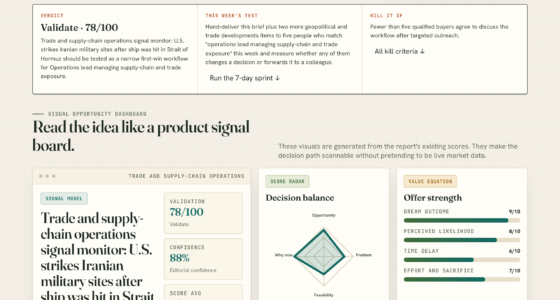

📊 Full opportunity report: Understanding Anthropic’s $965B Series H: The Compute Revolution on ThorstenMeyerAI.com — validation score, market gap, and execution plan.

Get smart everyday buys delivered free with Prime
- Fast, free delivery on millions of items
- Prime Video, Amazon Music and more included
- Member-only deals all year
TL;DR
Anthropic’s $965 billion valuation is driven by a strategic focus on securing compute infrastructure, not just company valuation. The round involves commitments from chipmakers and hyperscalers, highlighting hardware capacity as key to AI growth.
Anthropic has completed a $65 billion Series H funding round, valuing the company at $965 billion. This move is primarily aimed at securing the physical infrastructure—chips, memory, and power—needed to scale its AI models, rather than just increasing valuation figures. For a detailed analysis, see the original analysis on the compute revolution. The development signals a strategic shift in AI funding towards infrastructure investments critical for future growth.
Anthropic’s recent funding round, led by major investors including Amazon and strategic partners like Micron, emphasizes infrastructure over valuation alone. Over $10 billion in commitments from chipmakers and hyperscalers are dedicated to expanding data center capacity, high-speed memory, and power supply, which are seen as bottlenecks in AI scaling.
Revenue growth has been rapid, with Anthropic’s revenue escalating from around $1 billion late 2024 to a reported $47 billion annualized rate by early 2026—a 5.4× increase in four months. Despite this, the valuation multiple has decreased from 27× to approximately 20.5×, indicating market confidence in actual revenue growth rather than speculative future potential.
Major investors like Amazon have committed billions specifically for hardware infrastructure, signaling a shift in AI company strategies towards building physical capacity necessary for models like Claude to operate at internet scale. This infrastructure focus involves significant upfront investments but aims to eliminate hardware bottlenecks that could limit AI performance and growth.
$965B and climbing — it’s really a compute bet
The viral headline is the valuation. The interesting story is in the press release’s middle paragraphs — and in three chipmakers Anthropic just named as strategic partners. This is a capacity round dressed as a funding round.
The numbers nobody can quite parse in sequence
Read together they describe a trajectory with no precedent in enterprise software. Read individually, each looks like a typo.
From $61.5B to $965B in fourteen months
Salesforce took roughly two decades to reach revenue numbers Anthropic just blew past. The sequence below is the part most coverage skips — it’s not the size, it’s the shape.
Anthropic’s valuation ladder · Mar 2025 → May 2026
Five rounds, fourteen months. Bar height is the valuation; the climb itself is the story. Tap any milestone for context.
The multiple actually got cheaper
Bubbles look like multiples expanding while revenue lags. Anthropic’s pattern is the inverse — the valuation tripled, but revenue grew faster, and the multiple compressed.
Revenue-to-valuation multiple · Series G → Series H
Same company, three months apart. The denominator (revenue) is outrunning the numerator (valuation) — exactly the opposite of what a bubble narrative predicts.
10+ gigawatts and three chipmakers
When you name Micron, Samsung & SK hynix alongside your equity backers, you’re saying the binding constraint isn’t demand or model quality — it’s the physical supply of memory chips. The Series H is a capacity round.
Compute commitments backing Anthropic’s capacity bet
$200B+ in announced compute spend across multi-year contracts. The $65B Series H raise has to be read against that bill, not against operating losses.
A genuinely durable bet — or a structural exposure?
Both readings can be true at once. The answer arrives over the next 18–24 months as the gigawatts come online and either fill with paying demand or don’t.
Revenue growth has no precedent in B2B software ($1B → $47B in 17 months). The multiple is compressing, not expanding. Claude is the only frontier model on all 3 major clouds. Enterprise AI spend share went from ~10% to >65% in a year. Compute commitments are tied to specific contracts with capacity dates.
20× revenue is not cheap by any historical software-investing standard. Revenue is reported gross of cloud-reseller pass-throughs, which inflates the top line. Profitability is 2 years out. Amodei’s own warning: a 12-month delay in AI progress “would make him bankrupt” — the compute commitments are a structural exposure to demand persistence.
The valuation race — and the IPO context
Anthropic shipped Opus 4.8 the same morning as Series H — not a coincidence. One week after OpenAI filed confidentially for IPO. The late-2026 frame is set: two frontier AI companies racing to public markets, each pitching durability.
Why Infrastructure Investment Defines AI’s Future Growth
This funding round underscores a fundamental shift in AI development: the emphasis on physical infrastructure—chips, memory, and power—rather than solely on software or algorithms. As AI models grow larger and more complex, their success increasingly depends on the capacity of data centers and hardware supply chains. This move could accelerate AI capabilities but also introduces risks related to hardware shortages and supply chain disruptions, making infrastructure investments a critical determinant of AI’s future trajectory.
AI hardware infrastructure components
As an affiliate, we earn on qualifying purchases.
As an affiliate, we earn on qualifying purchases.
Recent Trends in AI Funding and Hardware Dependence
Leading up to this round, AI companies have seen their valuations soar, driven by rapid revenue growth and technological advancements. This trend highlights the importance of infrastructure investments in sustaining growth. Anthropic’s valuation tripled from $380 billion in February to nearly a trillion dollars by March 2026, while revenue surged from about $1 billion to nearly $47 billion. Despite the valuation increase, the declining valuation multiple indicates that investors are now prioritizing actual revenue growth and infrastructure readiness over speculative valuation.
Historically, AI scaling has been constrained by hardware limitations—particularly chips, memory, and power supply. Recent partnerships with chip manufacturers like Micron, Samsung, and SK hynix reflect a strategic move to address these bottlenecks directly, signaling a new phase where physical infrastructure becomes the core focus of AI expansion efforts.
“The hardware supply chain is now the bottleneck that will determine how fast AI can grow at this scale.”
— An anonymous industry executive
high-performance data center memory modules
As an affiliate, we earn on qualifying purchases.
As an affiliate, we earn on qualifying purchases.
Unclear Impact of Hardware Supply Chain Risks
It remains uncertain how effectively Anthropic and its partners can scale hardware supply chains to meet the aggressive capacity targets. Potential disruptions in chip production, memory shortages, or power infrastructure delays could slow AI deployment despite large investments. The long-term success of this infrastructure-focused strategy depends on mitigating these supply chain risks, which are still evolving and not fully predictable.
As an affiliate, we earn on qualifying purchases.
Next Steps in Infrastructure Expansion and AI Scaling
Anthropic and its partners are expected to accelerate hardware deployment, including large-scale data centers and supply chain scaling, over the coming months. Monitoring the progress of chip manufacturing commitments and infrastructure build-out will be crucial. Additionally, the company will likely report on how these investments translate into increased AI model performance and operational capacity, providing clearer metrics on the effectiveness of this infrastructure-centric approach.
As an affiliate, we earn on qualifying purchases.
Key Questions
Why is Anthropic focusing on hardware infrastructure rather than just software development?
Because the physical capacity of chips, memory, and power supply directly limits the size and speed of AI models. Investing in hardware infrastructure aims to remove these bottlenecks, enabling models like Claude to scale more effectively.
What does the $965 billion valuation really represent?
While it appears as a valuation milestone, the core of this number reflects a strategic investment in physical infrastructure—hardware, data centers, and supply chains—necessary for future AI growth.
Are there risks associated with this infrastructure-focused strategy?
Yes, supply chain disruptions, hardware shortages, and delays in infrastructure deployment could hinder AI scaling efforts and impact the company’s ability to meet growth targets.
How does revenue growth influence the valuation multiple?
Rapid revenue growth has caused the valuation multiple to decrease from 27× to around 20.5×, indicating that investors are increasingly valuing actual revenue and capacity rather than speculative potential.
Source: ThorstenMeyerAI.com
Fall Picks
fall essentials
As an affiliate, we earn on qualifying purchases.