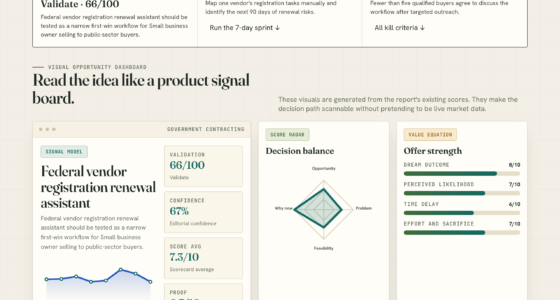

📊 Full opportunity report: The policy menu. There’s no single answer. There’s a menu — and choosing is a values choice in disguise. on ThorstenMeyerAI.com — validation score, market gap, and execution plan.
TL;DR
This article examines the range of policy responses to the economic shifts caused by AI, emphasizing that there is no single correct answer. Instead, choices reflect different societal values and trade-offs, with uncertainty about the labor-share shift remaining unresolved.
There is no single answer to how societies should respond to the economic shifts caused by AI; instead, there is a menu of options, each reflecting different values and trade-offs, with no clear consensus on which is best.
This analysis presents a set of policy responses—doing nothing, implementing universal basic income (UBI), promoting ownership models (UBC), and funding through data dividends—highlighting that each option optimizes for different societal values such as efficiency, security, agency, or fairness. The discussion underscores that these choices are moral and value-driven, not purely technical. The debate is often framed as a question of which policy is correct, but the reality is that each has strengths and weaknesses, and the best choice depends on societal priorities. The core uncertainty remains whether the labor share of income is actually declining—a question still unresolved. The analysis emphasizes that the funding mechanism (taxing workers versus common wealth) is a critical but often overlooked axis influencing policy effectiveness and fairness.The policy menu.
There’s no single answer.
There’s a menu — and
choosing is a values
choice in disguise.
shift isn’t real, catastrophic if it is
dignifying · fiscally heavy, cause-blind
robust · but slow, concentration-prone
under the question · funds either
The honest service is the menu itself: here are the options, here is what each optimizes for and trades away, here is the funding axis that matters more than the fight everyone is having. The decision is yours, the tradeoffs are real, and the one thing you should not accept is anyone telling you it’s obvious.Thorsten Meyer · The Policy Menu · Post-Labor 03 · Capstone
Understanding the policy menu clarifies that responses to AI-driven economic change are fundamentally moral choices, not purely technical fixes. This recognition shifts the debate from seeking a single ‘correct’ answer to evaluating which options align best with societal values. The uncertainty about the actual decline in labor share complicates decision-making, making robustness and flexibility essential. The choice of funding sources and redistribution methods will significantly influence social equity and economic stability, affecting future policy development and societal cohesion.

Shares in America: The Case For A Universal Basic Income
As an affiliate, we earn on qualifying purchases.
As an affiliate, we earn on qualifying purchases.
How the AI Transition Is Reshaping Economic Policy Debates
The discussion builds on prior analyses of AI’s impact on labor and wealth distribution, emphasizing that the economic shifts are complex and uncertain. Previous dispatches questioned whether the labor share is genuinely declining and explored the ownership-based responses. This final analysis consolidates these insights, framing policy options as a spectrum of value-based bets amid unresolved data on labor share trends. The debate often simplifies into technical correctness, but this analysis highlights the moral dimensions and the importance of robustness in policy choice.“A policy menu is honest only when each option is presented as its strongest advocates would present it and critiqued as its strongest critics would critique.”
— Thorsten Meyer
![[By Jocko Willink ] Extreme Ownership: How U.S. Navy SEALs Lead and Win (Hardcover)【2018】by Jocko Willink (Author) (Hardcover)](https://m.media-amazon.com/images/I/41ggaLUnBUL._SL500_.jpg)
[By Jocko Willink ] Extreme Ownership: How U.S. Navy SEALs Lead and Win (Hardcover)【2018】by Jocko Willink (Author) (Hardcover)
As an affiliate, we earn on qualifying purchases.
As an affiliate, we earn on qualifying purchases.
It remains unclear whether the decline in labor share is real and significant enough to justify specific policy responses. Data is still inconclusive, and the future trajectory of AI’s impact on income distribution is uncertain. Additionally, the effectiveness of funding mechanisms and the societal acceptance of various options are still developing issues, making it difficult to identify a definitive best course of action.
Dividend Growth Machine: How to Supercharge Your Investment Returns with Dividend Stocks
As an affiliate, we earn on qualifying purchases.
As an affiliate, we earn on qualifying purchases.
Next Steps in Policy Development and Debate
Further research is needed to clarify the trend in labor share and the impact of different funding models. Policymakers and advocates should focus on designing flexible, robust policies that can adapt as new data emerges. Public debate should shift toward values-based assessments, emphasizing transparency and the trade-offs of each option. Ongoing pilot programs and international experiments may also inform future decisions, but the core challenge remains balancing societal priorities amid persistent uncertainty.

Sovereign Wealth Funds: Legitimacy, Governance, and Global Power
As an affiliate, we earn on qualifying purchases.
As an affiliate, we earn on qualifying purchases.
Key Questions
What does the policy menu include?
The menu includes options such as doing nothing, implementing universal basic income (UBI), promoting ownership models (UBC), and funding through data dividends or sovereign wealth funds, each with different societal trade-offs.
Why is there no single correct policy response?
Because responses depend on societal values—efficiency, security, fairness—and because the data on labor-share decline remains uncertain, making any choice a moral and value-based decision rather than a purely technical one.
What is the main uncertainty affecting policy choices?
The key unresolved issue is whether the decline in labor share is real and significant enough to warrant specific policy interventions, as current data is inconclusive.
How should policymakers approach this menu?
They should evaluate options based on robustness—choosing policies that do least harm if their assumptions about the economy are wrong—and prioritize transparency about the values guiding their decisions.
What role does funding mechanism play in policy effectiveness?
Funding sources—taxing workers versus taxing common wealth—are critical, as they influence fairness, political feasibility, and the ability to implement or sustain policies over time.
Source: ThorstenMeyerAI.com